
Housing Industry Research Institute's October apartment move-in outlook index
Greater Seoul surges 17.2 points; metropolitan cities decline
National apartment occupancy rate rises 8.7 percentage points to 68.2%

Expectations for move-ins to newly built apartments have risen sharply in Greater Seoul even as Seoul apartment sale prices extended their record-breaking streak to 87 consecutive weeks of gains.
The Housing Industry Research Institute said Thursday that its October apartment move-in outlook index for Greater Seoul surged 17.2 points, climbing from 81.0 to 98.2, based on a survey of housing developers.
All areas within Greater Seoul posted sharp gains — Seoul (90.6 to 108.3, up 17.7 points), Incheon (65.3 to 89.2, up 23.9 points) and Gyeonggi Province (87.0 to 97.2, up 10.2 points). Seoul's index is particularly notable: after slipping from 100 in August to 90.6 in September, it rebounded to 108.3 in October, recovering within a month.
The national apartment move-in outlook index, however, fell 5.0 points to 82.6 in October from 87.6 in September. The index for metropolitan cities dropped 6.3 points (from 92.9 to 86.6), while provincial areas declined 12.1 points (from 86.0 to 73.9). The national index has now fallen for three consecutive months since July (97.5), slipping below its one-year average of 85.3.
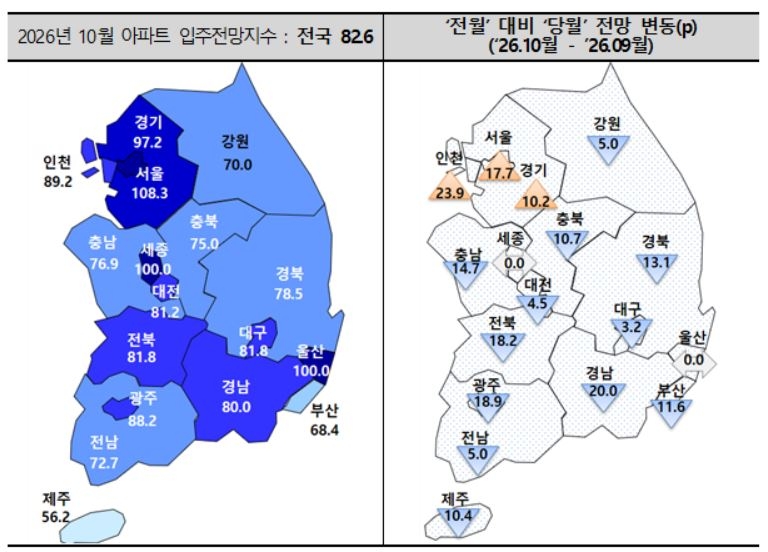
Among metropolitan cities, Gwangju (107.1 to 88.2, down 18.9 points), Busan (80.0 to 68.4, down 11.6 points), Daejeon (85.7 to 81.2, down 4.5 points) and Daegu (85.0 to 81.8, down 3.2 points) all recorded declines, while Ulsan (100.0) and Sejong (100.0) held steady from the previous month.
A Housing Industry Research Institute official said Gwangju's sharp drop reflected the short-term burden of absorbing a heavy volume of new move-ins, with about 5,700 units — roughly 66 percent of all provincial move-in supply — concentrated in the Gwangju and South Jeolla Province area, including large complexes in Buk-gu and the adjacent Jangseong area. In Busan, the designation of Gangseo-gu as an unsold-unit management zone in September added to concerns about a supply surge, with developers expecting conditions for selling existing homes and securing tenants to worsen.
All provincial areas also posted declines — South Gyeongsang Province (100.0 to 80.0, down 20.0 points), North Jeolla Province (100.0 to 81.8, down 18.2 points), South Chungcheong Province (91.6 to 76.9, down 14.7 points), North Gyeongsang Province (91.6 to 78.5, down 13.1 points), North Chungcheong Province (85.7 to 75.0, down 10.7 points), Jeju (66.6 to 56.2, down 10.4 points), Gangwon Province (75.0 to 70.0, down 5.0 points) and South Jeolla Province (77.7 to 72.7, down 5.0 points).
About 16,000 apartments are scheduled to be handed over nationwide in October — 7,924 units in Greater Seoul and 8,643 outside it — a roughly 65 percent increase from the previous month. Supply outside Greater Seoul is heavily concentrated in select areas, however, including the Gwangju and South Jeolla Province region. The institute said areas with concentrated move-ins could see simultaneous demand for financing to cover final payments and pressure to sell existing homes, and urged developers to identify and address potential obstacles to move-ins.
The national apartment occupancy rate in September stood at 68.2 percent, up 8.7 percentage points from August. Within Greater Seoul, Seoul's rate rose from 82.0 percent to 84.8 percent (up 2.8 percentage points), while the Incheon-Gyeonggi area slipped from 80.2 percent to 77.3 percent (down 2.9 percentage points), highlighting regional divergence even within the metropolitan area.
A Housing Industry Research Institute official said Seoul maintained a high occupancy rate in the mid-80 percent range as continued sale price gains kept conditions for disposing of existing homes relatively favorable. The official added, however, that tightened lending regulations have made securing final-payment loans a key constraint on move-ins across Greater Seoul as a whole.
Outside Greater Seoul, occupancy rates rose across all regions, though they remain clustered around 60 percent. The Gwangju-Jeolla region posted the sharpest gain (49.0 to 69.2 percent, up 20.2 percentage points), followed by the Daegu-Busan-Gyeongsang region (52.7 to 64.1 percent, up 11.4 percentage points), the Daejeon-Chungcheong region (56.8 to 67.3 percent, up 10.5 percentage points) and Jeju (59.1 to 65.1 percent, up 6.0 percentage points). Gangwon Province, which had no data recorded last month, posted an occupancy rate of 57.5 percent in September.
Provincial move-in volume in September totaled about 3,000 units, down more than 40 percent from the previous month and the lowest level of the year. The reduced supply created conditions for developers to focus on clearing unsold inventory at existing complexes, analysts said.
The leading reasons for failing to move in were inability to secure a final-payment loan (37.0 percent), delays in selling an existing home (31.5 percent), failure to secure a tenant (14.8 percent) and delays in selling pre-sale rights (5.6 percent) — a breakdown similar to the previous month.
Meanwhile, Seoul's October apartment pre-sale outlook index rose 11.8 points from the previous month to 105.7. The institute attributed the improvement to growing developer optimism in the pre-sale market, driven by continued price gains in areas outside the Han River belt of Greater Seoul amid a deepening shortage of jeonse and monthly rental housing.
hope@heraldcorp.com





