
Debate heats up again as Busan city and others take differing stances; Cultural Heritage Administration says pagoda is real estate regardless of relocation history
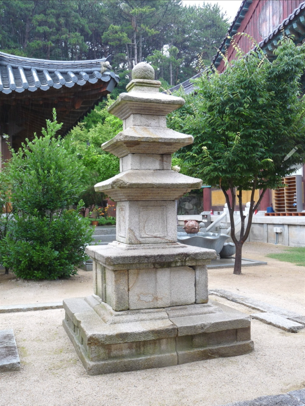
A three-story stone pagoda inside Haeeunjeongsa Buddhist temple in Haeundae-gu, Busan, is a designated tangible cultural heritage of Busan. It was listed as Busan Tangible Cultural Heritage No. 212 in April 2020.
The pagoda has recently become the center of a heated debate over whether it should be classified as movable property or real estate. A redevelopment project is underway in the Udong area where the temple is located — the Udong Zone 3 project, which calls for building 2,395 apartment units across 39 above-ground floors. If the pagoda is classified as real estate, it would trigger the designation of a cultural heritage protection zone and a historic and cultural environment preservation zone around it, imposing a range of restrictions on the surrounding area.
According to the Cultural Heritage Administration, the pagoda is a late Silla-period stone pagoda rooted in the Silla architectural style. It was originally relocated from Gyeongju to Daegu, then brought to Haeeunjeongsa in 2019 through a donation — the return of a cultural artifact removed during the Japanese colonial era.
Following the pagoda's arrival, Haeeunjeongsa applied to Busan city in 2020 for designation of a cultural heritage protection zone and a historic and cultural environment preservation zone under the Cultural Heritage Act. The application was rejected on the grounds that the pagoda did not qualify as real estate. A Busan city official said the pagoda had not originally been at the temple and had been brought in through a donation after passing through Gyeongju and Daegu. "It was something that was moved and brought here — I understand that was taken into consideration during the review," the official said.
The temple applied again this year for cultural heritage protection zone designation but was rejected again in late July. A city official said the 2020 rejection had already set a precedent, and noted that the application sought to designate a 500-meter radius around the pagoda as a protected zone — a scope that could affect thousands of residential units. Based on both the 2020 and July rejections, the city appears to have treated the pagoda as movable property.
The Cultural Heritage Administration, however, takes a different view. In a written response to a ruling party lawmaker's question at last week's national audit — asking whether a relocated stone pagoda should be considered movable property or real estate — the administration said: "A stone pagoda is a structure and is classified as tangible cultural heritage under Article 2 of the Cultural Heritage Act. While 'movable' and 'real estate' are not terms used in the classification of cultural heritage, structures are generally treated as real estate. Accordingly, a stone pagoda is a cultural heritage of a real estate nature, and whether it has been relocated is not considered in making that classification."
Article 99, Paragraph 1 of the Civil Act states that "land and fixtures attached to it constitute real estate," meaning that even a pagoda moved from another location would legally be treated as real estate if it is currently affixed to land within the temple grounds. A Supreme Court ruling — case No. 2007Da75853, issued in April 2009 — also treats unregistered trees, stone lanterns and stone pagodas as part of the land.
Haeeunjeongsa said the Cultural Heritage Administration's position and the Civil Act both point to the pagoda being real estate, and argued that the temple's three-story stone pagoda, as a Busan tangible cultural heritage, should naturally be designated as both a cultural heritage protection zone and a historic and cultural environment preservation zone. The temple also raised procedural concerns, saying the Haeundae-gu district office had approved a management and disposal plan for the redevelopment project before Busan city issued its rejection of the cultural heritage protection zone application in late July.
kaf2002@heraldcorp.com





