Defense committee delegation visits US Pacific Command in Hawaii from Nov. 1-5
US calls Gwangju air base relocation 'South Korea's sovereign decision'
Jin's entry approval delayed but visit proceeded as planned
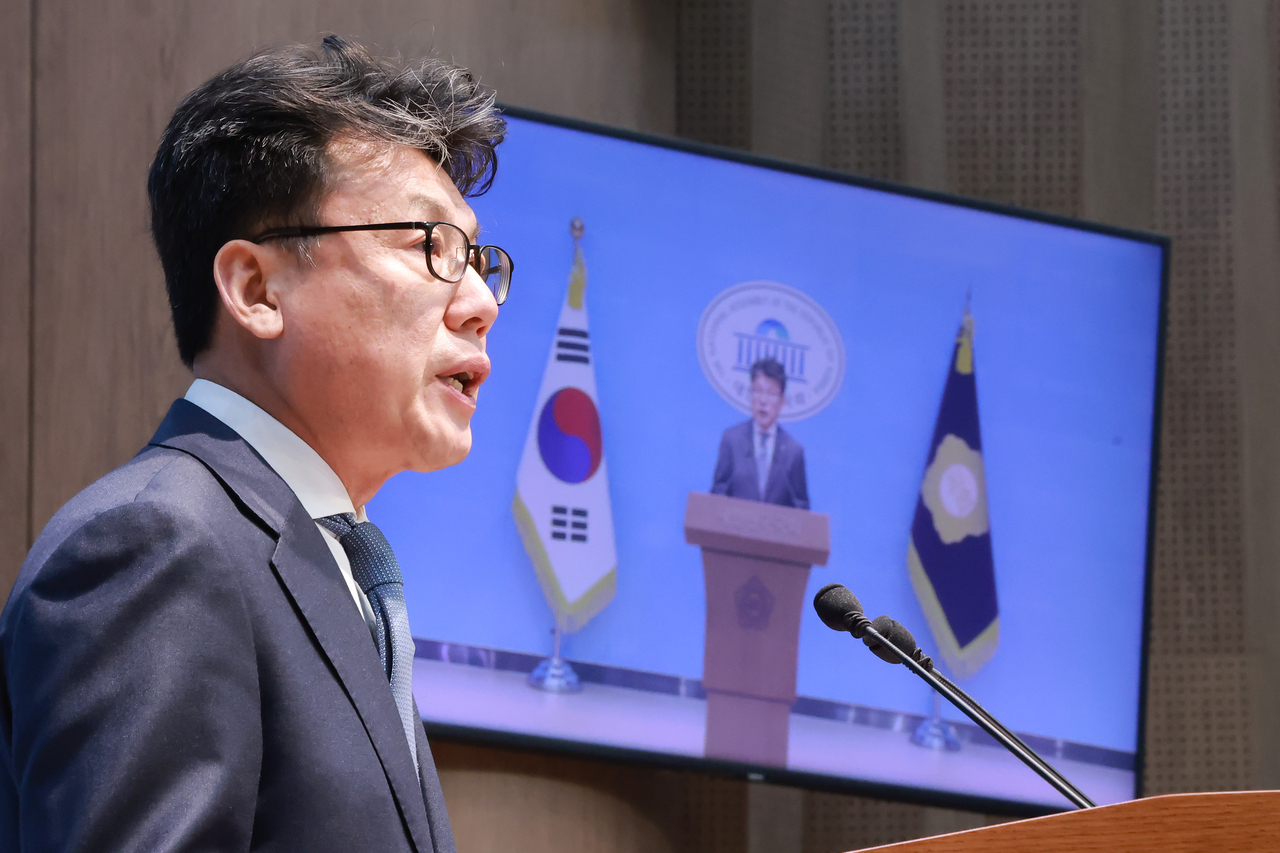
Jin Sung-joon, chairman of the National Assembly's National Defense Committee and a member of the Democratic Party of Korea, said Sunday that the United States confirmed its position that the conditions for transferring wartime operational control to South Korea remain unchanged.
Jin held a press conference at the National Assembly to report on the results of the defense committee delegation's four-night, five-day visit to the United States, which began Nov. 1, including a stop at the US military's Indo-Pacific Command in Hawaii.
On the OPCON transfer, Jin said the delegation conveyed South Korea's strong will to proceed, and that the US side, while acknowledging the possibility of some policy variables, confirmed that the existing bilateral agreement to carry out the transfer "based on conditions" remains intact and that those conditions have not changed to date.
Regarding the postponement of the annual South Korea-US Security Consultative Meeting — originally expected this month but now pushed to early next year — Jin said the US side explained the delay had nothing to do with any disagreement over the OPCON transfer, and was simply the result of scheduling the meeting around the availability of both countries' defense ministers and military leadership.
Jin said the visit underscored shared purpose between the two allies. "Both sides agreed that continuously strengthening and developing the South Korea-US alliance serves the interests of both countries amid an unstable international situation, and shared the goal of building a comprehensive, forward-looking alliance," he said.
Jin added that Indo-Pacific Command chief Adm. Samuel Paparo described South Korea as an exemplary ally worthy of trust, and pledged to faithfully fulfill alliance commitments while further solidifying the combined defense posture.
The delegation also exchanged views on the relocation of Gwangju Air Base, which is tied to plans to develop a semiconductor cluster in the Honam region as part of three major national megaprojects.
The base is currently being considered for relocation to Muan, a process that would require the temporary repositioning of US military facilities.
On that issue, Jin said Pacific Air Forces commander Gen. Kevin Schneider stated that the relocation of the air base is South Korea's sovereign decision, and that the US military's role is to review and advise on any military threat factors arising from the move.
On the Korean Peninsula security situation, Jin said the US side assessed conditions as relatively stable despite a series of North Korean moves in the demilitarized zone — including the demolition of inter-Korean road connections and the fortification of the MDL. The US side also said, however, that maintaining military alert readiness is necessary given North Korea's continued buildup of nuclear and missile capabilities and the possibility of sudden policy shifts.
Pacific Fleet commander Adm. Steven Koehler said South Korea's acquisition of nuclear-powered submarines could contribute to the development of the South Korea-US alliance, and pledged active cooperation if a policy decision is reached between the two sides.
Koehler also praised the South Korean military's operational capabilities in connection with the US-led multinational maritime exercise RIMPAC, and pledged to expand defense industry cooperation in the shipbuilding sector.
The delegation noted that although Jin's entry approval came late, the visit to the Indo-Pacific Command and its component commands proceeded as planned, with meetings held with commanders and other officials. The group said it received a warm welcome from the US military, including a commander's reception and a barge tour of the USS Arizona Memorial.
Jin had been notified of a US visa denial on Oct. 28, but was ultimately issued an official courtesy visa after South Korean diplomatic authorities requested cooperation, allowing the visit to go ahead.
The delegation included Democratic Party lawmaker Kim Byung-joo, People Power Party lawmaker Im Jong-deuk and Reform Party lawmaker Cheon Ha-ram.
shindw@heraldcorp.com