Inside Toss's 'Financial Lifestyle Class for New Parents'
20 spots drew 500-to-1 competition as parents flock to learn
Experts urge two-track strategy: children's independence and parents' retirement
Curriculum covers private tutoring costs, investment accounts and gift tax
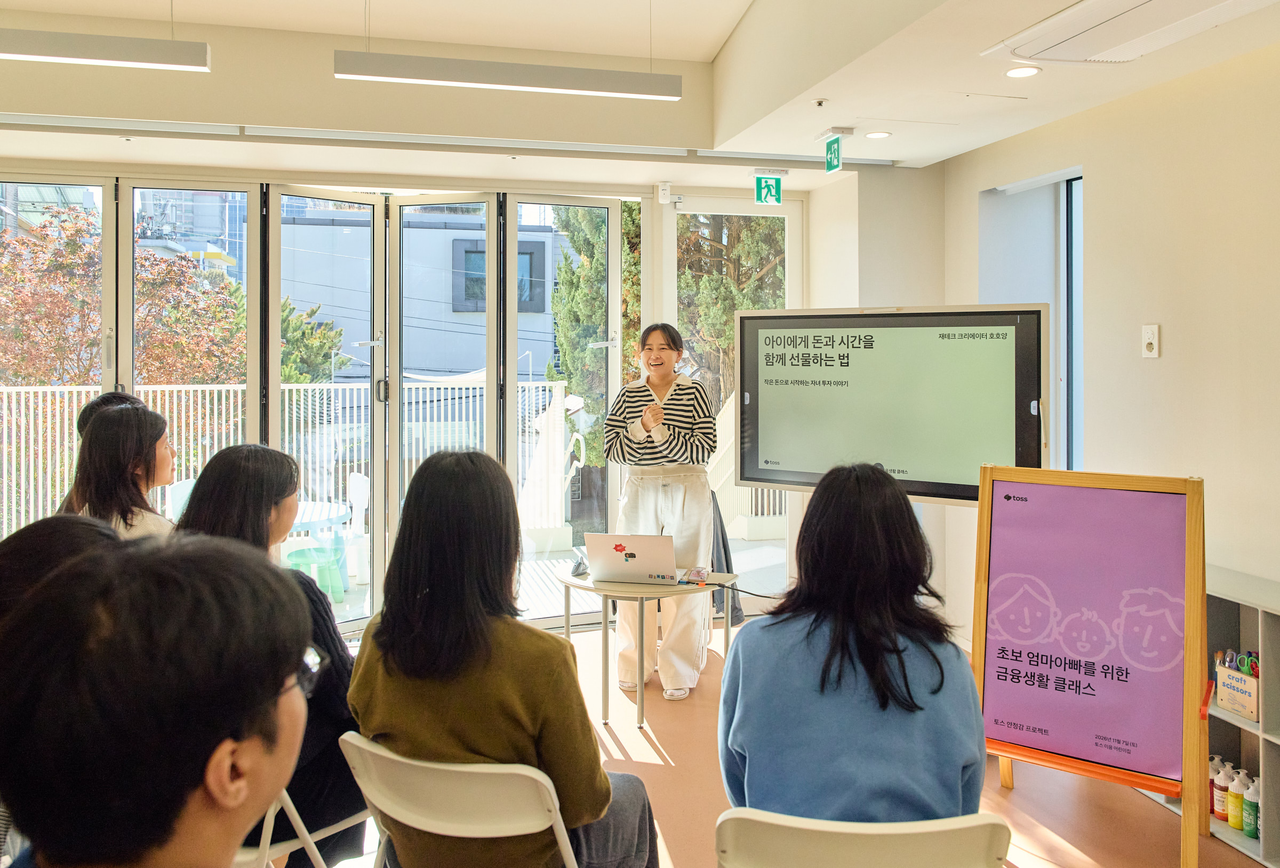
Kim Min-kyung, 33 and pregnant with a second child, boarded a train from Busan to Seoul at 5 a.m. Saturday to attend a financial education class for new parents. Kim had grown interested in personal finance during parental leave after the birth of a first child, and rising childcare costs with a second on the way prompted the trip. "Just the insurance premium for my first child is 100,000 won ($75) a month, and adding coverage for a second child doubles the burden," Kim said. "I signed up for the class because I wanted to know how many more unexpected fixed expenses were coming."
That morning, Toss held its "Financial Lifestyle Class for New Parents" at the Toss Eum Daycare Center in Gangnam-gu, Seoul. The session covered household financial management after childbirth, investment accounts opened in a child's name and gift tax strategies. The 20 spots across morning and afternoon sessions drew roughly 500 applicants — a competition ratio of about 500 to 1.
Park Ji-su, chief executive of Rabbit School, drew on her experience raising a daughter through university entrance preparations to argue that families need to reset their financial goals. "The 20 years before your child reaches adulthood are the golden window for building your family's financial foundation," Park said. "I believe the end goal of raising a child is economic independence." Park said parents need a two-track strategy — building funds for their children's future while simultaneously preparing for their own retirement.
Park particularly advised parents to set aside money for private tutoring costs well in advance. "High school tutoring costs should be prepared during elementary school, and middle school tutoring costs during kindergarten," she said. "If a child suddenly wants to take up sports, art or music, the expenses can pile up fast." She also suggested keeping a child's education fund and independence fund in separate accounts.
Finance YouTuber "Hohoyang" introduced strategies for investing and transferring assets in a child's name. "The reason to make early gifts to your child is to maximize the benefits of compound interest and tax savings," Hohoyang said. "Many people do not start because they do not have 20 million won right away, but gifting in smaller amounts whenever money becomes available is also an option." Under current tax rules, a minor child can receive up to 20 million won in gift tax deductions from direct lineal ascendants over a 10-year period. Hohoyang presented a hypothetical scenario showing that 20 million won invested over 20 years would grow to about 36.12 million won at a 3 percent annual return, or about 93.22 million won at 8 percent.
Hohoyang said the right type of account for a child depends on the investment goal. A standard brokerage account suits those who want to invest in individual stocks, while a pension savings fund is worth considering for long-term investment centered on domestically listed ETFs. "It is best to choose assets you can hold for 20 years when investing through a child's account," Hohoyang said, also recommending that parents keep records of gift dates, amounts and whether the transfers were reported to tax authorities.
After the session, one attendee asked whether allowance money given by family members or acquaintances also needs to be reported for gift tax purposes. "If it is spent as living expenses, it is not subject to gift tax, but if it is saved, invested and grown into an asset, it is safer to report it," Hohoyang said. Whether the money is actually taxed depends on how it is used and the amounts involved.
The class was part of Toss's "Stability Project," which the fintech company launched in August. The initiative aims to go beyond the convenience of financial services and address everyday anxieties. Alongside the event, Toss published the second issue of its lifestyle economics magazine, "The Money Issue," themed "Life Plans for New Parents." The issue covers 15 money topics new parents commonly wonder about, from postpartum care center costs and government support payments to children's accounts, insurance and gift transfers.
Ju Si-eun, head of corporate branding at Toss, said the way people view fintech is shifting — from "how innovative is it?" to "is it stable enough to be with me for the long haul?" "Toss has long worked to ease financial inconveniences, and now we want to pay attention to people's anxieties as well," Ju said.
Ju added that new parents' anxiety stems less from a lack of money than from a lack of knowledge. "When you have a child, there is a lot to manage — from government benefits to investment accounts and gift transfers in the child's name — but reliable information is hard to come by," Ju said. Toss plans to expand the program to consumers navigating other major life transitions, including those beginning to prepare for retirement.

snsd@heraldcorp.com