
- Clinical trial of 140 functional dyspepsia patients conducted by Korea Institute of Oriental Medicine
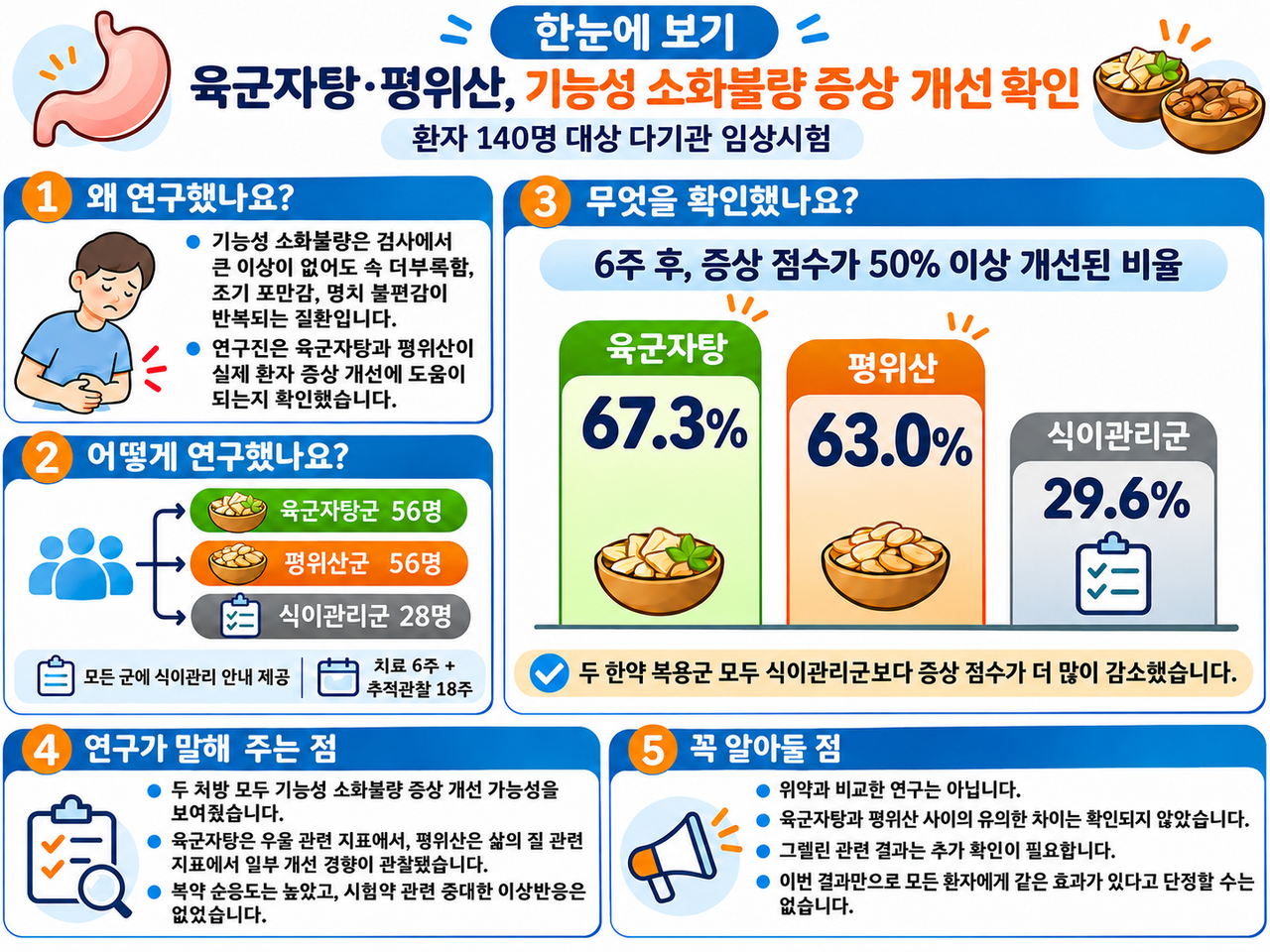
- Yukkunjatang: 67.3% improvement rate; Pyeongwisan: 63.0%; dietary management alone: 29.6%

A clinical trial has found that traditional herbal medicine may help relieve symptoms in patients with functional dyspepsia — a condition marked by post-meal bloating and early satiety. Six to seven out of 10 patients who took one of two widely used herbal prescriptions for six weeks saw their symptoms improve by more than half.
The Korea Institute of Oriental Medicine announced Tuesday that a joint research team led by senior researchers Lee Bo-ram and Yang Chang-seop confirmed the symptom-relieving effects of Yukkunjatang and Pyeongwisan in a clinical trial involving 140 functional dyspepsia patients.
Functional dyspepsia is a condition in which patients repeatedly experience post-meal bloating, early fullness and epigastric pain despite showing no abnormalities on endoscopy. Although Yukkunjatang and Pyeongwisan are widely prescribed for dyspepsia in traditional Korean medicine clinics, clinical evidence comparing their effectiveness and safety in domestic patients had been limited.
The research team conducted a randomized controlled clinical trial with 140 patients recruited from three medical institutions: Kyung Hee University Korean Medicine Hospital, Semyung University Jecheon Korean Medicine Hospital and Daejeon University Daejeon Korean Medicine Hospital.
Patients were divided into three groups — 56 taking Yukkunjatang, 56 taking Pyeongwisan and 28 receiving dietary management only — and followed for six weeks. All participants received dietary management guidelines, while the two herbal medicine groups also received their respective prescriptions.
As a result, both herbal medicine groups showed statistically significant reductions in dyspepsia symptom scores compared with patients who received dietary management alone.
The proportion of patients whose symptom scores improved by 50 percent or more was 67.3 percent in the Yukkunjatang group and 63.0 percent in the Pyeongwisan group — approximately 2.3 times and 2.1 times higher, respectively, than the 29.6 percent recorded in the dietary management group.
However, no statistically significant difference in treatment effect was found between Yukkunjatang and Pyeongwisan.
Improvements in quality of life were also observed. Both herbal medicine groups scored better on quality-of-life assessments related to functional dyspepsia than the dietary management group. The Yukkunjatang group additionally showed improvements in depression-related assessment scores and in traditional Korean medicine indicators of "spleen qi deficiency."
The research team also analyzed ghrelin — a hormone that regulates appetite and gastrointestinal motility — to investigate the mechanism by which herbal medicine affects digestive function.
While some changes in ghrelin-related indicators were observed in both herbal medicine groups, no statistically significant differences were found compared with the dietary management group, indicating that further research is needed to clarify the mechanism of action.
In safety assessments, medication adherence rates in the two herbal medicine groups were 95.6 percent and 92.6 percent, respectively. No serious adverse reactions related to the trial drugs were reported during the study period.
However, the study was not a placebo-controlled trial, and no statistically significant between-group differences in key symptom scores were found during long-term follow-up after treatment ended. Follow-up clinical trials are therefore needed to assess long-term treatment effects.
"This study is significant in that it confirmed the symptom-improving effects of Yukkunjatang and Pyeongwisan — both widely used in traditional Korean medicine practice — through a domestic multi-center clinical trial," Lee and Yang said. "We will continue to verify the efficacy and mechanisms of herbal medicine through placebo-controlled trials and long-term follow-up research."
The findings were published online Aug. 24 in the Journal of Ethnopharmacology.
nbgkoo@heraldcorp.com





