Chinese research team's meta-analysis on myopia prevention pulled two months after publication over data manipulation
Lutein shown to lower progression risk in intermediate macular degeneration patients
Attention scores improved in screen-heavy teens in clinical trial

'Staring at a smartphone all day, then a monitor — eyes feeling strained, maybe some lutein?'
Lutein is one of the most popular eye health supplements. A yellow pigment found in abundance in dark leafy greens such as spinach and kale, it concentrates in the macula — the central region of the retina — where it is believed to help shield the eye from light damage.
South Korea's Ministry of Food and Drug Safety recognizes lutein as a functional ingredient when taken at 10 to 20 milligrams per day, acknowledging that it can help maintain macular pigment density, which may decline with age, thereby supporting eye health.
Recent research on lutein, however, draws a sharp line between where its benefits are well established and where expectations have run ahead of the evidence. A study claiming it could prevent myopia in adolescents has been retracted over data manipulation.
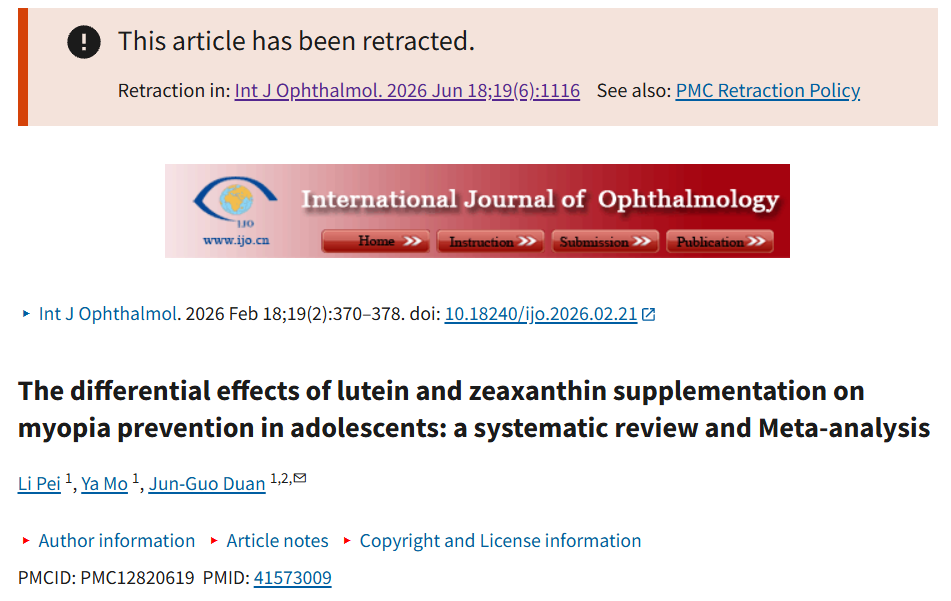
Study on lutein and myopia prevention in teens retracted over data manipulation
A Chinese research team published a meta-analysis in the International Journal of Ophthalmology in February, claiming that lutein and zeaxanthin could slow the progression of myopia in adolescents. Zeaxanthin is a pigment similar to lutein that also accumulates in the macula.
The team said it pooled results from 10 randomized clinical trials involving 1,035 adolescents with myopia and found that those who took lutein and zeaxanthin showed less elongation of the eyeball from front to back.
Myopia progresses as the eyeball lengthens along its axis, and axial length is the standard measure used to track that progression.
The team's claim that greater and longer intake produced stronger effects drew a challenge from a columnist writing in Townsend Letter, a US journal covering alternative and integrative medicine. The columnist said that despite years of reviewing nutritional therapy literature, no study using lutein or zeaxanthin as a myopia treatment had ever come to their attention.
After an investigation, the journal retracted the paper on April 30. The retraction notice stated explicitly: "This article contains data manipulation."
Where lutein's benefits are confirmed: macular degeneration
The strongest evidence for lutein's effectiveness is in age-related macular degeneration. The condition causes the macula to deteriorate with age, blurring and distorting central vision and, in severe cases, leading to blindness.
The US National Eye Institute conducted a large-scale clinical trial — known as AREDS2 — beginning in the mid-2000s to examine the effects of a supplement combination containing lutein and zeaxanthin in patients with intermediate macular degeneration.
A 10-year follow-up published by the research team in JAMA Ophthalmology in 2022 found that those who took lutein and zeaxanthin had a lower risk of their macular degeneration advancing to a late stage — 15 percent lower than those who took beta-carotene.
By contrast, those who took beta-carotene had nearly twice the risk of lung cancer, while lutein and zeaxanthin showed no meaningful increase in that risk. The research team concluded that lutein and zeaxanthin were appropriate substitutes for beta-carotene.

What about screen-heavy teenagers?
A clinical trial targeting teenagers with heavy screen use has also recently emerged.
A research team at Clinical Research Australia, a clinical research organization in Australia, published results in the journal Nutrition Research in June from a clinical trial involving 82 adolescents aged 13 to 18 who spent more than four hours a day looking at screens and ate few vegetables and fruits. Participants took 10 milligrams of lutein and 2 milligrams of zeaxanthin — or a placebo — daily for six months.
Teenagers who took lutein showed increased macular pigment density. Their scores on tests measuring attention and information-processing speed also improved compared with those who took the placebo. However, no differences were found in memory, visual reasoning or performance on a shooting game. Self-reported concentration and sleep quality also showed no change.
The research team said further study was needed targeting adolescents with low macular pigment density or problems with concentration and sleep.
Under South Korean guidelines, certain groups should exercise caution with lutein. The Ministry of Food and Drug Safety advises infants, young children, pregnant women and breastfeeding mothers to avoid it. The ministry also notes that excessive intake can temporarily cause the skin to turn yellow.
Many people think of lutein as a supplement for tired eyes, but the functional benefit the Ministry of Food and Drug Safety has officially recognized is not eye fatigue relief — it is the maintenance of macular pigment density.
Lutein also does not have to come from supplements. It is found in abundance in green vegetables such as spinach, kale and broccoli, as well as in egg yolks.
References
DOI : 10.1001/jamaophthalmol.2022.1640
Chew EY, Clemons TE, Agrón E, et al. Long-term outcomes of adding lutein/zeaxanthin and ω-3 fatty acids to the AREDS supplements on age-related macular degeneration progression: AREDS2 report 28. JAMA Ophthalmol. 2022;140(7):692-698.
DOI : 10.18240/ijo.2026.02.21
Pei L, Mo Y, Duan JG. The differential effects of lutein and zeaxanthin supplementation on myopia prevention in adolescents: a systematic review and meta-analysis. Int J Ophthalmol. 2026;19(2):370-378. Retracted in: Int J Ophthalmol. 2026;19(6):1116.
Retraction Notice [retraction of: Int J Ophthalmol. 2026 Feb 18;19(2):370-378. doi: 10.18240/ijo.2026.02.21.]. Int J Ophthalmol. 2026;19(6):1116. Published 2026 Jun 18.
DOI : 10.1016/j.nutres.2026.06.005
Lopresti AL, Smith SJ. Supplementation with lutein and zeaxanthin increases macular pigment optical density and cognitive performance in healthy teenagers in a randomized, double-blind, placebo-controlled trial. Nutr Res. 2026;152:132-144.
dbsdn1110@heraldcorp.com