Four ultra-large vessels secured with Korea Ocean Business Corp. ship financing
Fleet to expand to 128 ships by 2030, targeting 5 million vehicles annually and 20% global market share
LNG dual-fuel engines and shore power systems installed for green compliance
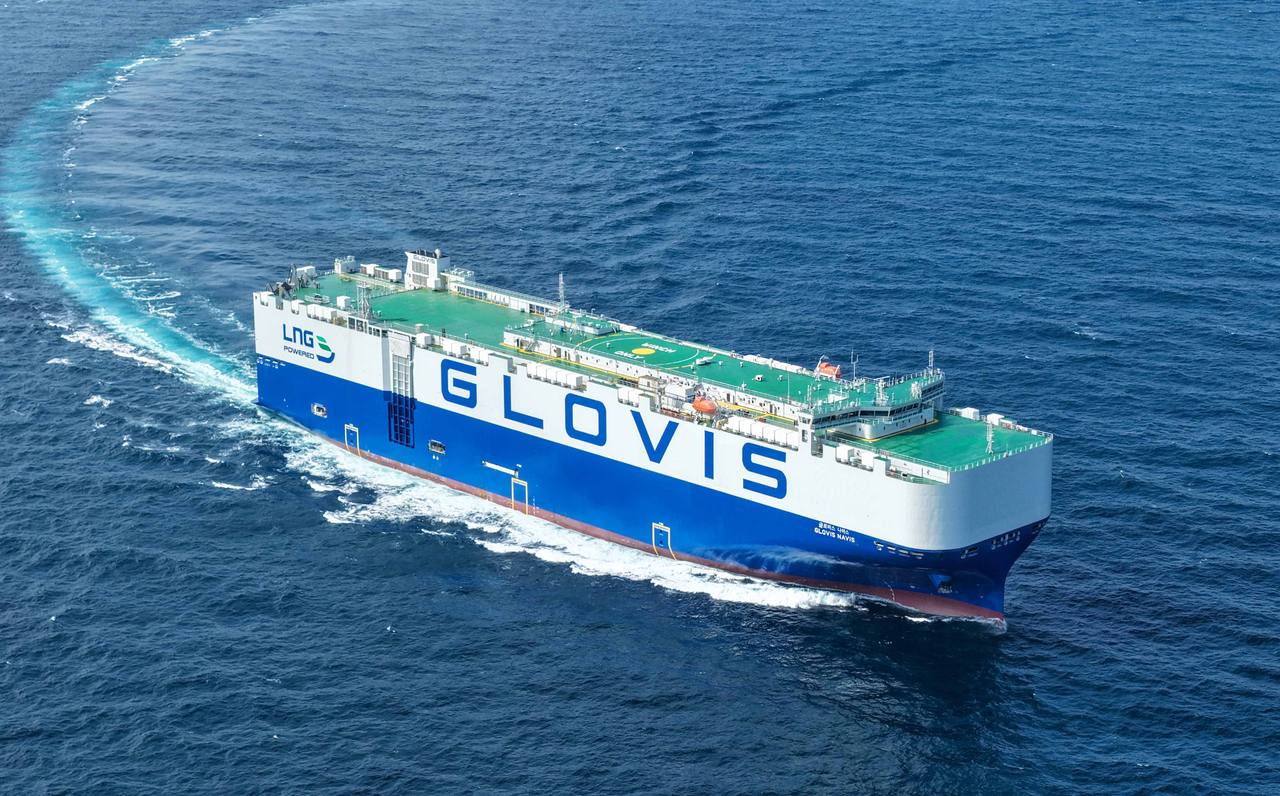
Hyundai Glovis has secured what it says is the world's largest car carrier, a vessel capable of transporting 10,800 vehicles in a single voyage. The ultra-large ship, acquired with financing from the Korea Ocean Business Corp. (KOBC), is designed to support South Korean automakers' exports while strengthening the company's position in the global maritime vehicle transport market.
Hyundai Glovis held a naming ceremony Thursday for the pure car and truck carrier (PCTC) Glovis Navis at the GSI shipyard in Guangzhou, China, and immediately deployed the vessel for finished-vehicle maritime transport.
The ceremony was attended by Hyundai Glovis President and CEO Lee Gyu-bok, along with representatives from KOBC and the shipyard, who gathered to wish the vessel safe voyages.
The Glovis Navis measures 230 meters in length and 40 meters in width. Its interior features 14 decks of vehicle storage space, accommodating up to 10,800 compact cars. It is the largest car carrier by cargo capacity currently in service.
Five of the 14 decks are designed with adjustable heights, allowing the ship to carry a wide range of cargo beyond passenger cars — including SUVs, buses, trucks and construction equipment.
The vessel's introduction is a result of an MOU signed in 2024 between Hyundai Glovis and KOBC to secure ultra-large 10,800-vehicle PCTCs.
The two parties agreed to cooperate in response to a shortage of car carriers that had been hampering South Korean automakers' ability to ship their vehicles overseas. Under the arrangement, KOBC provides policy financing to fund vessel acquisition, while Hyundai Glovis operates the ships on a long-term basis.
A total of four ultra-large car carriers are to be secured under the agreement. The Glovis Nova was the first to be delivered, in July, followed by the Noble and the Navis this month. The final vessel, the Nautilus, is scheduled for delivery in February next year.
Particularly significant is an arrangement under which the new ships will give priority berthing space to South Korean automakers when they cannot find vessels to ship their export volumes. The aim is to ensure stable export logistics for domestically produced vehicles and reduce supply chain disruptions caused by a shortage of shipping capacity.
The global maritime vehicle transport market has been grappling with a persistent shortage of car carriers, driven largely by a surge in finished-vehicle exports from China. Longer voyage times resulting from route diversions due to Middle East conflicts, combined with growing demand to replace aging vessels, have intensified competition for available shipping capacity.
Hyundai Glovis has been proactively expanding its fleet with larger vessels to respond to these market shifts. The company's strategy centers on ultra-large 10,800-vehicle carriers to improve per-vessel transport efficiency and meet the export needs of global automakers.
The Glovis Navis is also equipped for environmentally conscious operations. The ship features a dual-fuel propulsion engine capable of running on LNG as well as conventional marine fuel. Using LNG reduces carbon emissions compared with traditional petroleum-based marine fuels, helping the company comply with tightening international maritime environmental regulations.
The vessel is also fitted with an alternative maritime power (AMP) system that allows it to draw electricity from shore while berthed, reducing the need to run onboard generators in port and cutting air pollutant emissions in surrounding harbor areas.
Hyundai Glovis plans to add 10 more LNG dual-fuel car carriers with 10,800-vehicle capacity next year. Measured in equivalent 6,500-vehicle-capacity units, the company aims to expand its average annual operating fleet from about 106 ships in the third quarter of this year to 110 ships in 2027, 118 in 2028, 123 in 2029 and 128 by 2030.
Alongside the fleet expansion, Hyundai Glovis plans to strengthen its transport services for global automakers by linking overseas port operations with inland logistics networks. The company intends to improve route efficiency by leveraging key logistics hubs including Philadelphia in the United States and Amsterdam in the Netherlands, while also diversifying its cargo beyond passenger vehicles to include commercial vehicles and construction equipment.
The company's goal is to grow its annual finished-vehicle maritime transport volume from about 3.4 million units currently to 5 million by 2030 — a level that would represent roughly 20 percent of global finished-vehicle maritime cargo.
"The introduction of the Glovis Navis is the result of our efforts to secure ultra-large PCTCs in cooperation with KOBC," a Hyundai Glovis official said. "We will lead the global maritime vehicle transport market on the strength of an eco-friendly, high-efficiency fleet while providing stable logistics support for automobile exports."
kwater@heraldcorp.com