People with borderline intelligence fall into a support gap, excluded from welfare programs because they are not classified as disabled; Seoul Metropolitan Government to hold policy forum Tuesday
Nearly four in 10 members of a Seoul city center for people with borderline intelligence who scored above IQ 70 were found to have daily-life adaptation skills below the standard threshold, according to new data.
The Seoul Metropolitan Government said Sunday that an analysis of data from 1,000 members of the Mim Center — the city's lifelong education support center for people with borderline intelligence — found that 58 of 147 members (39.5%) who scored above IQ 70 and took a social maturity assessment had a social quotient (SQ) below 75.
The social quotient measures a person's ability to manage daily life independently and maintain relationships with others, with an average score of 100. A score below 75 is generally considered to indicate significant difficulty with daily-life adaptation.
People with borderline intelligence do not meet the criteria for intellectual disability but may face challenges in learning, social life and employment due to cognitive characteristics and difficulties with adaptive behavior. Critics have long argued that using IQ alone to determine eligibility for support has clear limitations.
A Seoul city official said the findings point to the need for a comprehensive assessment that looks at daily-life adaptation skills — such as the ability to use public transportation and maintain interpersonal relationships — alongside IQ.
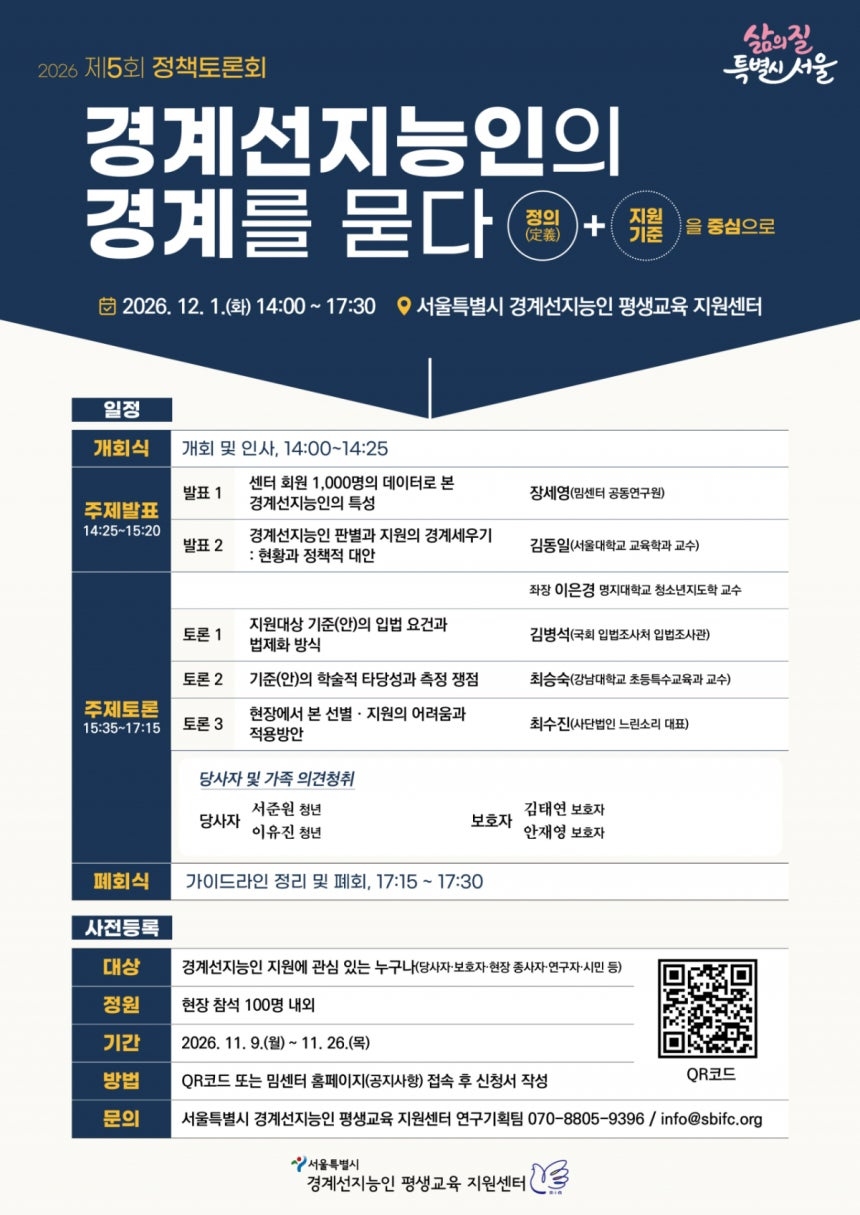
In response, the Seoul Metropolitan Government will hold a policy forum to develop support criteria that take both IQ and daily-life adaptation ability into account. The Mim Center will host its fifth policy forum, titled "Questioning the Boundaries of Borderline Intelligence: Focusing on Definitions and Support Criteria," on Tuesday from 2 p.m. to 5:30 p.m.
The forum will use the analysis findings as a basis for discussing criteria for identifying who qualifies for support and for proposing policy improvements.
National Assembly lawmakers, special education experts, practitioners and people with borderline intelligence themselves, along with their guardians, will take part in the forum to explore ways to close the support gap and establish a legal framework.
The Seoul Metropolitan Government has been expanding lifelong education support through the Mim Center and other channels to help people with borderline intelligence live independently and participate in society. Last month, it launched MIM NET, a support network for people with borderline intelligence.
People with borderline intelligence are largely excluded from existing welfare programs on the grounds that they are not classified as disabled, leaving them in what advocates call a "support blind spot." Most struggle across a range of settings — school, the workplace and the home — and their difficulties are compounded by a lack of appropriate support.
Seoul became the first city in the country to enact a lifelong education support ordinance for people with borderline intelligence in 2020 and established the Mim Center in 2022.
Lee Hae-seon, director of the Seoul Metropolitan Government's Lifelong Education Bureau, said the city would work toward establishing support criteria that reflect the characteristics of people with borderline intelligence and their need for assistance.
ken@heraldcorp.com