Ruling party pushes for bill this year despite failed labor-management talks
Phased increase from 61 in 2029, rising one year every two years; mandatory rehiring to run in parallel
Business lobby warns blanket extension would add 30.2 trillion won annually in labor costs
Youth hiring squeeze and labor market polarization remain key hurdles
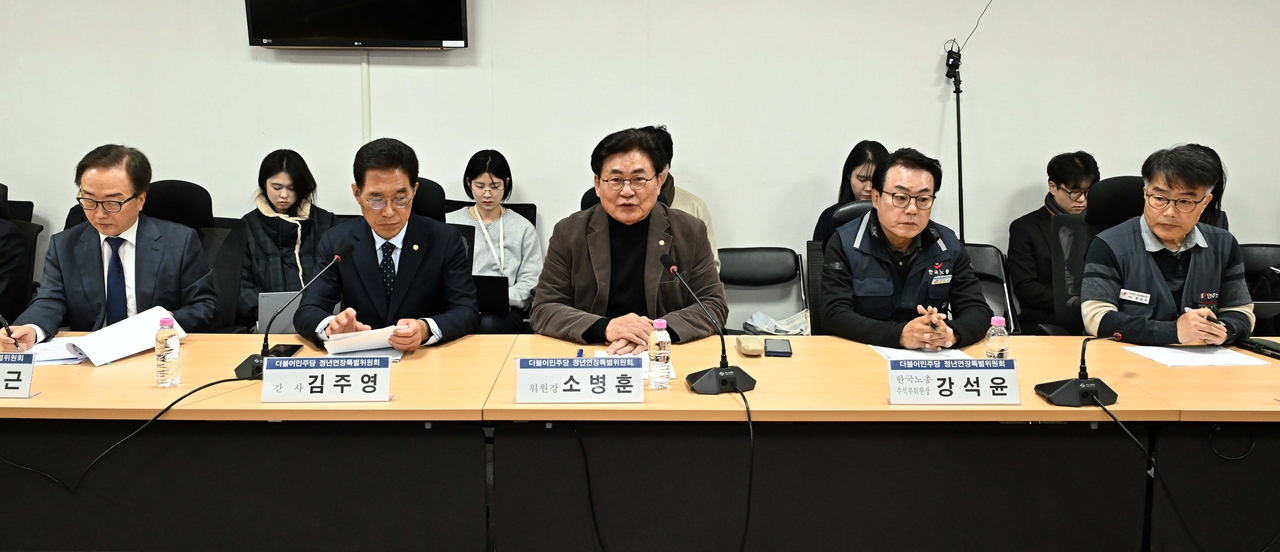
Legislation to gradually raise the statutory retirement age to 65 by 2037 is moving into full legislative gear. With labor and management failing to reach agreement on how to extend the retirement age and restructure the wage system, the ruling party is now set to drive the bill forward on its own. The measure aims to close an income gap of up to five years between the statutory retirement age and the age at which workers become eligible for national pension benefits, but significant challenges remain — including rising labor costs for companies, a potential chilling effect on youth hiring, and deepening labor market polarization.
According to the National Assembly and related ministries, the Democratic Party of Korea's special committee on retirement age extension plans to hold its final plenary session on Wednesday and wrap up its activities. After labor and management failed to narrow their differences at a subcommittee meeting on Friday — the first in 10 months — the committee intends to introduce a bill before the end of the year regardless of whether the two sides reach an agreement.
Statutory retirement age to rise from 2029; mandatory rehiring to reach 65 by 2035
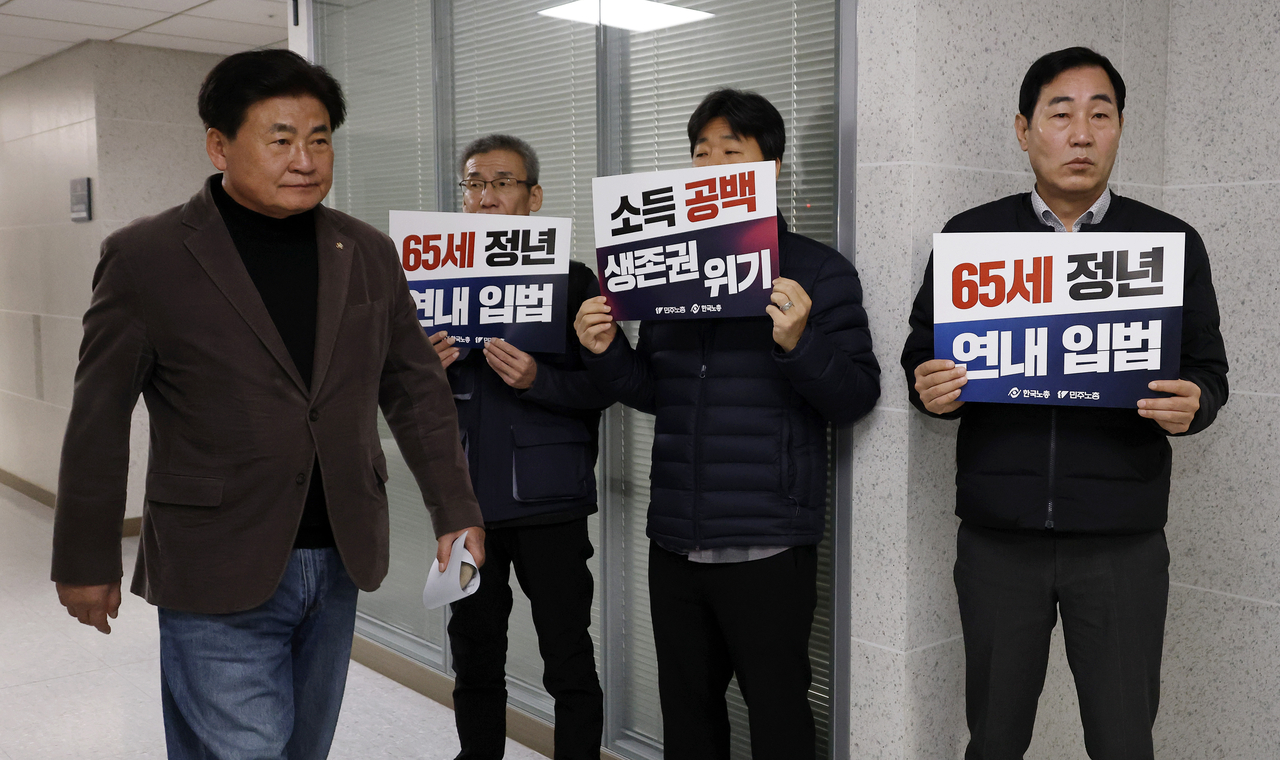
The bill is expected to include a phased retirement age increase combined with a mandatory rehiring scheme — a compromise the committee crafted to balance the demands of both labor and management.
Under the plan, the current statutory retirement age of 60 would rise to 61 in 2029, then increase by one year every two years — reaching 62 in 2031, 63 in 2033, 64 in 2035, and 65 in 2037.
A mandatory rehiring system would also be introduced to protect workers who retire during the transition period. The mandatory rehiring age would start at 61 in 2028 and rise to 62 in 2029, 63 in 2031, 64 in 2033, and 65 in 2035 — guaranteeing continued employment from two years before the statutory retirement age reaches 65 until that threshold is met.
Special provisions to ease the burden on companies are also being pursued. For the period of extended employment created by the retirement age increase, companies would be allowed to revise workplace rules — including the wage system — without the consent of a majority union or a majority of workers, on a temporary exceptional basis. Under current labor standards law, any revision to workplace rules that is unfavorable to workers requires the consent of a majority union or a majority of the workforce.
The Ministry of Employment and Labor, the lead ministry on the issue, plans to participate in the National Assembly's legislative review process to help resolve specific points of contention rather than announce a separate government bill. Once introduced, the bill will undergo full review by the National Assembly's climate, energy, environment and labor committee.
Up to five-year income gap before pension; business costs and youth employment on collision course
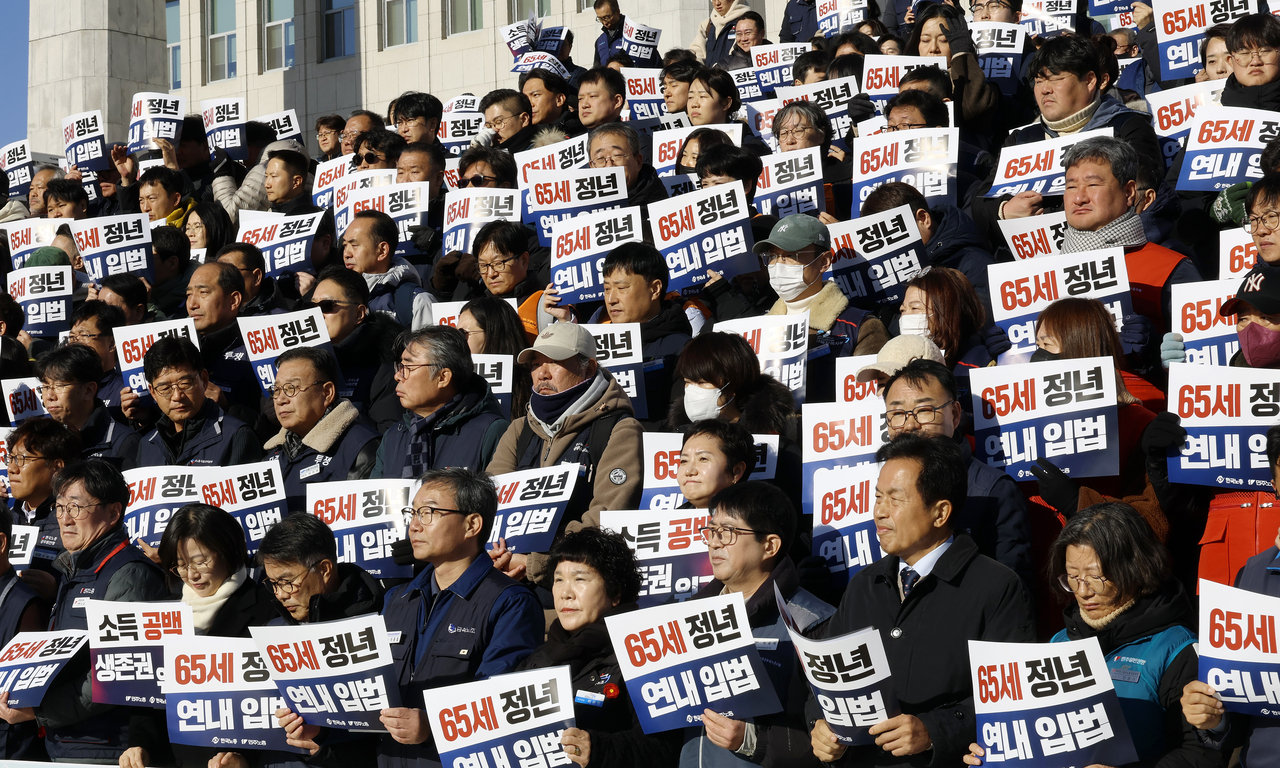
The debate over raising the retirement age stems from a growing gap between the statutory retirement age and the age at which workers can begin drawing national pension benefits.
While the statutory retirement age remains at 60, the national pension eligibility age is set to rise to 64 in 2028 and 65 in 2033. Under the current system, workers born in 1969 or later who retire at 60 could face an income gap of up to five years before their pension kicks in. That disparity has fueled calls to narrow the gap between the retirement age and pension eligibility, particularly as a way to ease poverty among older Koreans.
Both labor and management agree on the need to expand continued employment in response to an aging population. However, labor unions are pushing for a statutory extension of the retirement age that preserves existing employment relationships, while business groups favor a rehiring-centered approach in which new contracts are drawn up after retirement.
The central sticking point is the wage system. Under the seniority-based pay structure prevalent in South Korea, where wages rise with years of service, simply extending the retirement age without reforming pay could sharply increase labor costs for companies.
The Korea Enterprises Federation estimated that a blanket extension of the statutory retirement age to 65 would saddle companies with an additional 30.2 trillion won ($22.5 billion) in annual labor costs. Business groups warn that such a cost increase could reduce companies' capacity to hire young workers, intensifying job competition between generations.
Labor unions, by contrast, argue that a rehiring-based approach is likely to result in older workers being shifted to one-year fixed-term contracts with reduced pay. They contend that if working conditions deteriorate significantly even as employment is extended, the original purpose of raising the retirement age — securing income in old age — would be undermined.
Benefits may flow only to large firms and public institutions; labor market polarization a concern
The risk that raising the retirement age could deepen the dual structure of the labor market is another challenge lawmakers must address.
The benefits of the new system are likely to be concentrated among full-time workers at large companies and public institutions, where employment tends to remain stable until the statutory retirement age. For workers at small and mid-sized or micro enterprises, and for non-regular workers who leave their primary jobs before reaching retirement age, the practical impact of the extension could be limited.
Major economies have adopted different continued-employment systems tailored to their own labor market structures.
Japan last year made it fully mandatory for companies to secure employment up to age 65, giving firms the choice of extending the retirement age, rehiring retirees, or abolishing the retirement age altogether. More than 70 percent of Japanese companies have opted for the rehiring approach. Germany, meanwhile, is responding to its aging population by gradually raising the pension eligibility age to 67 by 2031.
Jung Heung-jun, a professor in the business administration department at Seoul National University of Science and Technology, said the wage gap between regular and non-regular workers in Japan is relatively small, and employment can be maintained even when companies are given a choice — but that South Korea's disparities by union presence and company size are far greater. "If we go with a rehiring-centered approach, polarization will only worsen," Jung said.
Jung added that a phased statutory extension of the retirement age is unavoidable to bridge the income gap between ages 60 and 65. "The government needs to provide carefully designed support — guidelines on role adjustments and wage system reform, and measures to ease job competition with young workers," Jung said.
Park Ji-soon, a professor at Korea University School of Law, said the labor movement's demand for "same position, same pay" retirement age extensions would entrench a high-cost structure for companies and become a major obstacle to hiring young workers.
Park added that after age 60 and until pension eligibility begins, workers should be guaranteed employment stability — not short one-year contracts — but companies should be given broad flexibility to redesign job duties and wage structures, provided a reasonable minimum wage floor is in place.
fact0514@heraldcorp.com