![케빈 워시 미국 연방준비제도(Fed·연준) 의장이 지난 4월 21일 지명자 신분으로 워싱턴 D.C. 의회에서 열린 상원 은행위원회 인사청문회에 출석해 발언하고 있다. [로이터]](https://wimg.heraldcorp.com/news/cms/2026/06/15/news-p.v1.20260609.28743f807ced40b28f9cce9318ff6279_P1.jpg)

오는 16·17일(미국 현지시간) 케빈 워시는 연방준비제도(Fed·연준) 의장으로서 첫 회의를 주재한다. 도널드 트럼프 대통령은 1년 가까이 공을 들인 끝에 마침내 자신이 원하던 중앙은행 수장을 손에 넣었다. 인준안은 지난 5월 찬성 54표 대 반대 45표라는, 역대 연준 의장 중 가장 아슬아슬한 표차로 상원을 통과했다. 하지만 새 의장이 가장 먼저 하게 될 일은 그를 임명한 대통령을 실망시키는 것일 가능성이 크다. 그는 금리를 인하하지 않을 것이다. 이는 반항이 아니다. 지금의 경제 데이터가 요구하는 당연한 결과다.
트럼프 대통령이 지난 1월 워시를 의장으로 지명했을 때만 해도 통화 완화(금리 인하)를 주장할 만한 근거는 제법 그럴듯했다. 전체 물가상승률(소비자물가지수)이 2.4%로 내려앉았고, 2025년 시작된 디스플레이션(물가상승률 둔화)이 마무리 국면에 접어든 것처럼 보였다. 대출 금리 인하를 공약으로 내걸었던 대통령 입장에서는 당연히 금리가 내려가리라 기대할 만했다. 하지만 그 직후 중동 분쟁이 터지면서 유가가 치솟았다.
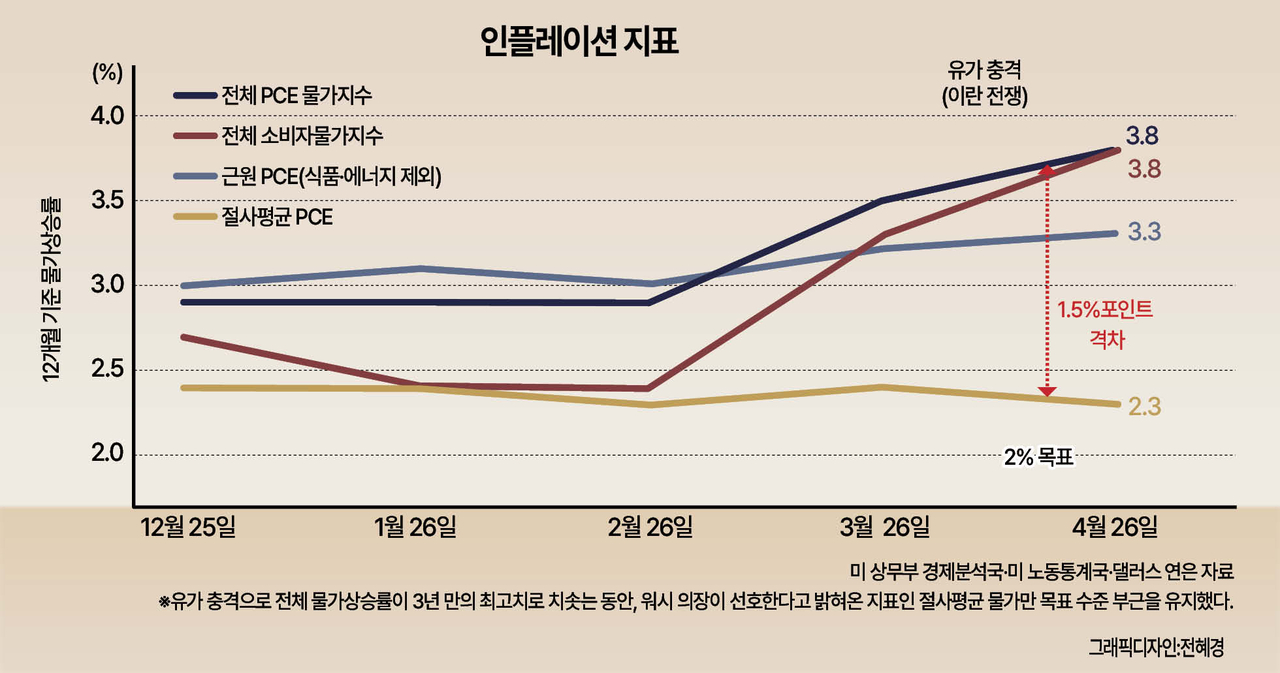
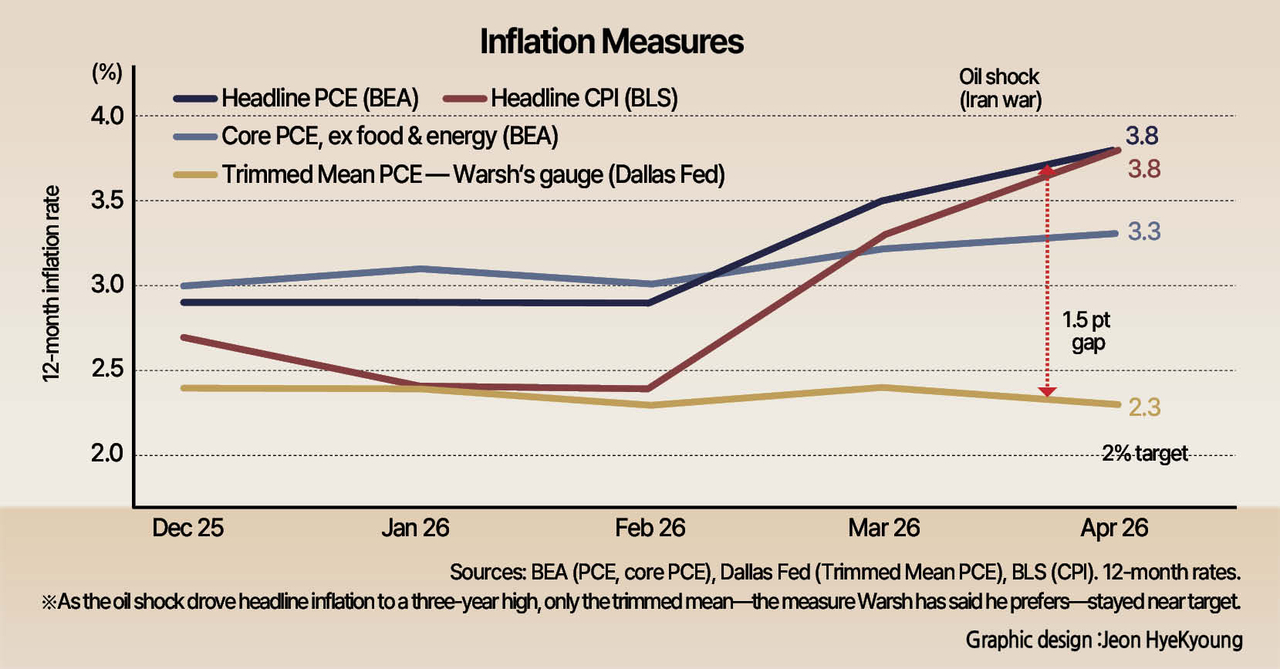
4월에 이르자 휘발유 가격은 3년 만에 처음으로 갤런당 4달러를 돌파했다. 소비자물가와 연준이 가장 눈여겨보는 개인소비지출(PCE) 물가지수 모두 거의 3년 만에 가장 가파른 속도인 3.8%까지 치솟았다. 더 우려스러운 점은 기조적인 물가 흐름을 나타내는 근원 PCE 물가지수마저 3.3%로 올랐다는 사실이다. 변동성이 큰 지표와 변동성이 적고 안정적이라던 지표가 모두 동일하게 우려스러운 방향으로 움직인 것이다.
노동시장도 워시 의장의 방어막이 돼 주지 못하고 있다. 고용 시장이 다소 진정되긴 했지만 실업률은 여전히 낮고 경제는 위축되지 않았다. 다시 고개를 든 인플레이션 위험을 상쇄할 만큼 노동시장에 비상이 걸린 상황은 아니라는 뜻이다.
시장도 이런 변화에 빠르게 적응했다. 올해 초만 해도 연방기금금리 선물 시장은 연내 금리 인하를 점치고 있었다. 하지만 지금은 정반대 방향을 가리키고 있다. 이번 주 동결은 기정사실이며, 12월까지 금리가 인상될 확률이 절반을 넘어섰다. 그럼에도 백악관의 압박은 전혀 줄어들지 않았다. 대통령은 자신이 앉힌 의장이 출근했으니 여전히 금리가 내려가기를 기대한다. 이 기대치와 연방공개시장위원회(FOMC)가 실제로 내놓을 결과물 사이의 간극이 바로 워시 의장의 첫 회의를 관통하는 핵심 긴장 구도다. 중앙은행의 독립성이란 실제로 이처럼 작동한다. 눈앞에 놓인 데이터를 바탕으로 위원회가 내리는 엄격한 규율의 결과물이다.
12표 중 단 1표
여기서 연준이라는 조직의 역학 관계를 살펴볼 필요가 있다. 의장은 막강한 영향력을 행사하지만, 금리 결정은 독단으로 내릴 수 없다. 권위만큼이나 ‘설득’이 중요한 FOMC를 통해 결정된다.
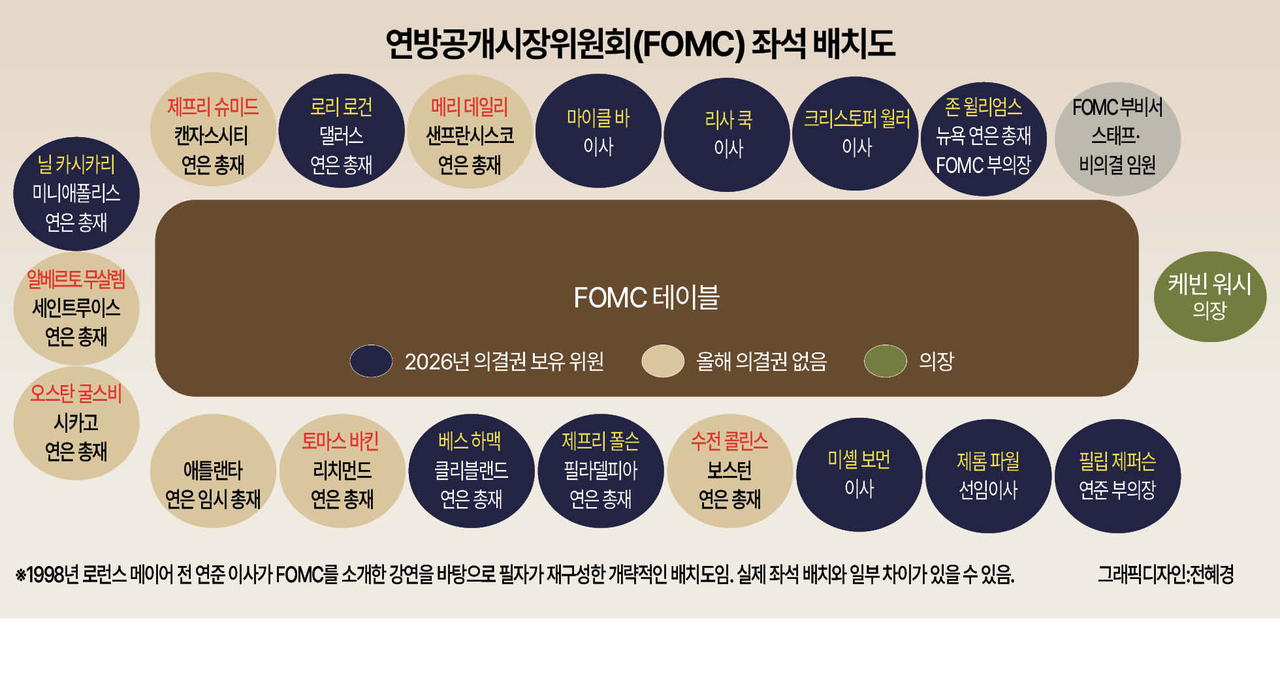
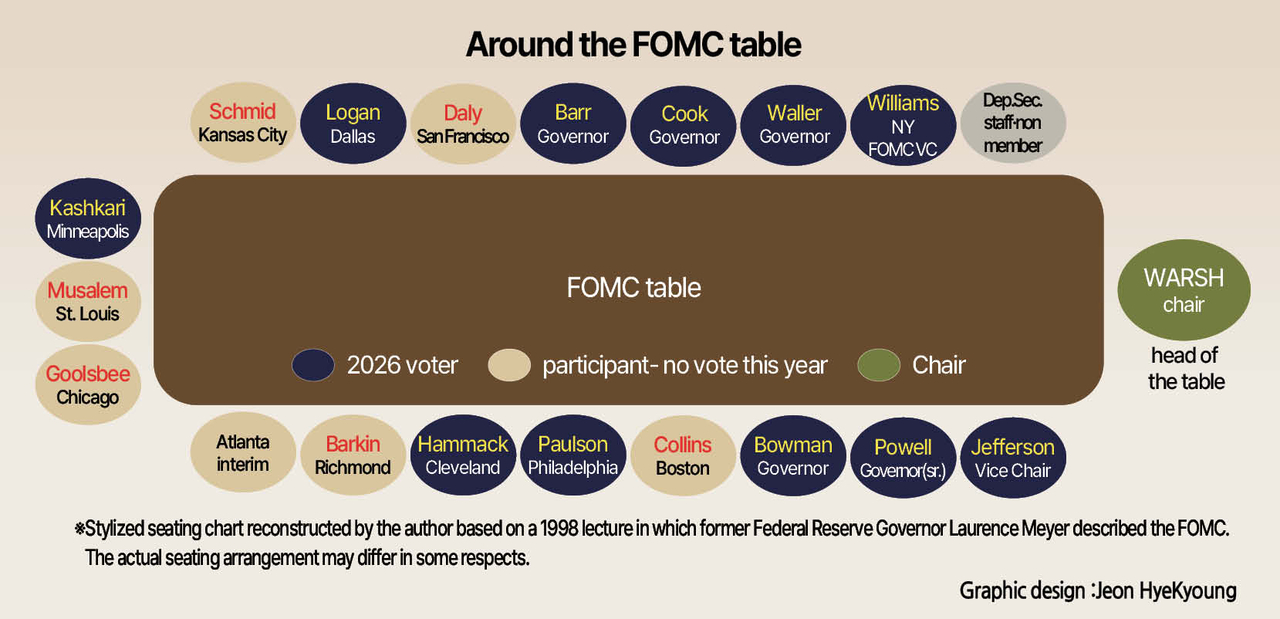
금리 결정 논의에는 총 19명의 정책위원이 참여하지만, 실제 투표권을 가진 위원은 12명뿐이다. 워싱턴의 연준 이사 7명, 당연직으로 항상 투표권을 갖는 뉴욕 연준 은행 총재, 그리고 나머지 11개 지역 연준 은행 총재 중 매년 1월마다 번갈아 가며 투표권을 갖는 4명이다. 그런데 올해 로테이션은 백악관에 그리 유리하게 흘러가지 않았다. 올해 새로 투표권을 얻은 지역 연은 총재 4명 중 3명(댈러스의 로리 로건, 클리블랜드의 베스 해맥, 미니애폴리스의 닐 카시카리)이 대표적인 인플레이션 매파(통화 긴축 선호)다. 이들 세 명은 제롬 파월 전 의장의 마지막 회의였던 지난 4월 FOMC 성명서의 완화적 표현에 모두 반대 표를 던졌다. 당시 회의에서는 금리 인하와 인상 양방향 모두에서 반대 의견이 나오며, 새 수장이 오기도 전에 위원회가 이미 분열되고 있음을 시사했다.
존 케네디 상원의원이 청문회에서 워시 의장에게 말했듯, 대통령이 연준을 ‘일방적으로’ 좌지우지할 수 있는 의장을 앉힐 수 있다고 생각하는 사람은 누구든 실망하게 될 것이다. 의장은 자신을 제외한 11명의 위원을 설득해야 한다. 연준은 철저히 합의로 움직이는 기관이다.
공식적인 표 대결에서 워시 의장이 패배할 가능성은 낮다. 현대 연준 역사에서 의장이 표 대결에서 지는 경우는 거의 없다. 의장들은 대개 결정을 내리기 전에 위원회의 기류를 파악하며, 통과시키지 못할 결정을 무리하게 밀어붙이지 않기 때문이다. 하지만 정작 중요한 문제는 워시 의장이 투표에서 이길 수 있느냐가 아니라, ‘논리 싸움’에서 이길 수 있느냐다.
그 시험대에서 보면 그의 첫 회의는 벌써부터 험난해 보인다. 워시 의장이 금리 인하의 명분 없이 취임한 건 아니다. 그에겐 생산성 향상론, 물가지표 측정론, 대차대조표 연계론이라는 세 가지 경로가 있었다. 하지만 지난 몇 주 사이 이 세 가지 모두 활용하기가 훨씬 어려워졌다.
좁아져 버린 세 갈래 길
첫 번째 경로는 인공지능(AI)이다. 워시 의장은 AI를 우리 세대에서 가장 강력한 생산성 혁신이라고 부르며, 이는 구조적으로 물가를 낮추고 경제의 잠재성장률을 높여 통화 정책을 완화할 여지를 만들어줄 것이라고 주장해 왔다. 하지만 그조차도 이를 확실한 상수로 보지는 않았다. 그는 청문회에서 공급 측면의 부양 효과가 “생각보다 훨씬 클 수 있다”고 인정하면서도 “아직 알 수 없으며, 이를 기정사실로 믿고 정책을 펼 수는 없다”고 한발 물러섰다.
동료 위원들의 반응은 더 직설적이다. 파월 전 의장은 지난 3월, 데이터센터 건설 붐이 단기적으로는 오히려 물가를 밀어 올리고 있을 가능성이 크며, 중립금리를 낮추기보다 높일 수 있다고 지적했다. 리사 쿡 연준 이사 역시 5월 말, 약 1조5000억 달러 규모로 발표된 대형 프로젝트들을 언급하며 “AI로 인한 투자 수요 급증으로 물가에 또 다른 충격이 더해질 수 있다”고 경고했다. 알베르토 무살렘 세인트루이스 연은 총재는 가장 단도직입적으로 표현했다. “오늘날의 인플레이션 문제를 해결하기 위해 미래의 생산성 향상 전망에 기대는 것은 위험하다”
이게 워시 의장의 문제다. 생산성 향상이라는 배당금은 진짜일지 모르지만, 아직 금리 인하를 정당화할 만큼 눈에 보이지 않는다. 반면 데이터센터 구축 비용은 전력, 장비, 건설 수요의 형태로 이미 지표에 반영되고 있다. 워시 의장 자신도 AI 투자가 단기적으로 수요를 자극해 물가를 몇 십분의 일 퍼센트포인트라도 끌어올린다는 점을 인정한다. 그의 논리가 장기적으로는 맞을지 몰라도 시점이 문제다. 물가 상승이 먼저 오고, 생산성 향상은 나중에 오기 때문이다.
두 번째 경로는 물가 측정 방식이다. 워시 의장은 전체 물가상승률과 식료품·에너지를 제외한 기존의 근원 물가지수 모두를 불신한다. 대신 매달 가장 극단적인 가격 변동을 제외하고 물가의 중간값에 집중하는 ‘절사평균’ 지표를 선호한다. 그는 상원에서 “더 이상 대강 짐작할 필요가 없다”고 말하기도 했다.
얼핏 보면 이 지표는 그에게 유리해 보인다. 전체 물가가 3.8%에 달했던 4월에도 댈러스 연은의 절사평균 PCE는 목표치에 근접한 2.3%였기 때문이다. 하지만 이 위안거리마저 위태롭다. 첫 회의를 불과 며칠 앞두고, 정작 이 지표를 산출하는 댈러스 연은의 로리 로건 총재는 최근의 낮은 수치가 착시일 수 있다고 경고했다. 최근 물가가 오르는 품목과 내리는 품목이 특이하게 섞여 있는 탓에, 지표 계산 과정에서 실제로 가격이 오른 항목들까지 너무 많이 깎여 나갔다는 주장이다. 그녀는 기조적인 인플레이션을 나타내는 다른 지표들은 3% 안팎이나 그 이상을 기록하고 있다고 덧붙였다.
결과적으로 그에게 금리 인하의 가장 좋은 명분이 돼 줄 수 있었던 지표가, 다름 아닌 그 지표를 만드는 기관에 의해 의문이 제기된 셈이다.
세 번째 경로는 조금 더 미묘하면서도 워시 의장의 생각이 가장 독창적으로 드러나는 부분이다. 그는 연준의 두 가지 핵심 도구인 금리와 대차대조표가 “서로 다른 목적을 위해 사용되는 것이 아니라 함께 작동해야 한다”고 주장한다.
이론적으로는 금융 여건을 긴축시키는 대차대조표 축소(양적 긴축)를 계속 진행하면서, 동시에 금리를 낮춰 경제를 완화하는 방식이다. 두 조치가 서로를 상쇄하기에, 연준은 시장에 지나친 자극을 주지 않으면서도 금리를 낮출 수 있게 된다.
그러나 이 길 역시 좁아지고 있다. 대차대조표는 줄어들지 않고 있다. 양적 긴축(QT)은 지난해 12월 종료됐고, 연준은 은행의 준비금을 ‘풍부한’ 수준으로 유지하기 위해 매달 약 400억 달러 규모의 단기 국채를 사들이고 있다. 즉, 워시 의장이 구상한 전략 중 ‘긴축’을 담당할 축이 지금은 작동 불가능한 상태다. 현대 연준의 운영 체계는 오히려 반대 방향을 요구한다.
돈의 양을 줄이면서 동시에 돈의 가격(금리)을 낮추려던 의장은, 정작 두 번째 레버가 움직이지 않는 현실과 마주한 것이다. 문제는 이들 논리가 비현실적이라는 데 있지 않다. 문제는 세 논리 모두가 가장 좋지 않은 시점에 사용하기 어려워졌다는 데 있다. 그리고 이런 반론들은 현직 이사들과 지역 연은 총재들, 투표권 보유자와 비보유자를 가리지 않고 제기되고 있다.
조직 내 역학 관계도도 워시 의장에게 불리하게 돌아갔다. 파월 전 의장은 이례적으로 의장직을 마친 뒤 연준을 떠나지 않았다. 그는 이사직을 유지했다. 이는 1948년 마리너 에클스 이후 처음 있는 일이다. 따라서 그는 여전히 12명의 투표권자 중 한 명이며, 이제는 후임자인 워시 의장이 이끄는 위원회에 참여한다. 워시 의장이 대체한 인물이 당분간 그가 필요로 할 수도 있는 한 표가 된 셈이다.
시험대가 된 점도표
이 모든 상황으로 인해 이번 주의 초점은 기준금리 결정 자체가 아니라, 그 결정을 둘러싼 연준의 커뮤니케이션에 맞춰지고 있다. 워시 의장은 연준이 향후 금리 방향에 대한 사전 안내(포워드 가이던스), 무엇보다도 ‘점도표(dot plot)’에서 벗어나야 한다는 입장을 숨기지 않아 왔다. 점도표는 19명의 통화정책 결정자들이 향후 금리 전망을 표시하는 분기별 차트다. 그는 상원 청문회에서 “과거와 현재의 많은 동료들과 달리 나는 포워드 가이던스를 신뢰하지 않는다”고 말했다.
그의 견해에는 충분히 설득력 있는 논리가 있다. 워시 의장은 점도표가 연준을 낡은 전망에 가둬둘 수 있다고 주장한다. 상황이 변했음에도 정책 결정자들이 과거 예측을 방어하도록 만들 수 있다는 것이다. 점도표를 폐지하거나 최소한 비중을 줄이는 건 그가 수년간 주장해 온 개혁 의제와도 일치한다.
그러나 시점은 매우 미묘하다. 점도표는 단순한 소통 수단이 아니다. 올해 투표권이 없는 지역 연은 총재들까지 포함해 19명 전원의 견해가 드러나는 유일한 장치이기도 하다. 만약 유가 급등 이후 FOMC의 무게중심이 더욱 매파적(hawkish) 방향으로 이동했다면, 6월 점도표는 그 변화를 가장 명확하게 보여주는 지표가 될 것이다. 이 때문에 워시 의장은 어려운 선택에 직면하게 된다. 그는 예년처럼 점도표를 공개해 백악관이 기대하는 것보다 덜 비둘기파적인 위원회의 모습을 드러낼 수도 있다. 또는 점도표가 지나친 정밀성을 제공하는 것처럼 보이게 만든다고 주장하며 공식적으로 중요도를 낮출 수도 있다. 또 다른 방법도 있다. 전망치는 그대로 공개하되 자신은 점을 찍지 않고, 기자회견에서 그 이유를 설명하는 것이다. 이는 점도표를 폐지하는 건 아니지만, 의장 취임 후 첫 회의부터 점도표의 권위를 약화시키는 효과를 낼 수 있다.
어느 선택에도 대가는 따른다. 첫 번째 선택은 내부 이견을 드러낸다. 두 번째 선택은 상황에 맞춰 편의적으로 행동한 것처럼 보일 수 있다. 세 번째 선택은 공식 선언 없이도 점도표의 위상을 낮추는 결과를 낳는다. 시장 측면의 비용도 있다. 가이던스가 줄어들수록 투자자들은 더 적은 정보로 더 많은 것을 추론해야 하며, 장기 금리는 회의 때마다 더 크게 움직일 수 있다.
17일엔 주목해야 할 세 가지가 있다. 중요도가 낮은 것부터 높은 순서다. 첫째는 금리 결정 자체다. 기준금리는 3.50~3.75% 수준에서 동결될 가능성이 높다. 둘째는 경제전망이다. 점도표가 얼마나 중요한 위치를 유지하는지, 워시 의장이 자신의 점을 제시하는지, 그리고 중간값이 금리 인상 쪽으로 기우는지 여부를 살펴봐야 한다. 셋째는 기자회견이다. 이 자리에서 ‘워시 의장 체제 연준’의 정책 기조가 본격적으로 드러나기 시작할 것이다.
더 근본적인 이야기는 워시 의장이 무력하다거나 누군가의 도구라는 게 아니다. 그는 연준이 어디에서 잘못됐는지에 대해 일관된 진단을 갖춘 진지한 개혁가일 수 있다. 그러나 개혁가 역시 눈앞의 현실에서 자유로울 수는 없다. 그리고 이번 달에는 경제적 현실과 제도적 현실이 같은 방향을 가리키고 있다.
워시 의장은 연준 내부의 솔직한 토론과 의견 충돌을 강조해 왔다. 그는 상원 청문회에서 “의견 차이가 존재하는 것은 전혀 문제가 아니다”라고 말했다. 이제 그는 실제로 그런 의견 차이를 마주하게 됐다. 연준은 스스로 논쟁할 의지가 있지만, 그 방향은 그가 기대했던 방향과는 다를 수 있다. 그는 표결에서는 승리할 것이다. 그러나 논쟁의 흐름은 자신에게 불리하게 돌아가고 있음을 발견할 수도 있다. 경제지표 속에서, 점도표 속에서, 한때 그가 환영했던 동료들의 이견 속에서 말이다. 만약 그가 대통령의 요구에 따라 금리를 인하하는 대신, 증거가 요구하기 때문에 금리를 동결한다면 그것은 이 제도가 여전히 제대로 작동하고 있다는 가장 강력한 신호가 될지도 모른다.
![Kevin Warsh, to be sworn in as chair of the Federal Reserve, testifies before a Senate Banking Committee confirmation hearing on Capitol Hill in Washington, D.C., April 21. [REUTERS]](https://wimg.heraldcorp.com/news/cms/2026/06/15/news-p.v1.20260615.4bbeb637b91b48ca8cf1a25750398c17_P1.jpg)
The Chair Who Can’t Cut
On Tuesday and Wednesday, June 16 and 17, Kevin Warsh will lead his first meeting as Chairman of the Federal Reserve. President Trump finally has the central banker he spent the better part of a year pursuing, confirmed in May by the narrowest Senate vote any Fed chair has ever received, 54 to 45. And the first thing the new chair will almost certainly do is disappoint the man who appointed him. He will not cut interest rates.
That is not defiance. It is what the data now require.
When Trump chose Warsh in January, the case for easing looked respectable. Headline inflation had drifted down to 2.4 percent, the disinflation of 2025 seemed to be completing itself, and a president who had campaigned on cheaper borrowing could reasonably expect lower rates. Then the Middle-East conflict sent oil prices soaring.
By April, with gasoline back above $4 a gallon for the first time in three years, both consumer prices and the Fed’s preferred PCE index were rising at 3.8 percent, the fastest pace in nearly three years. More worryingly, the underlying reading rose too, with core PCE reaching 3.3 percent. The volatile measure and the supposedly steadier one were moving in the same, uncomfortable direction.
The labour market gives Warsh little cover. Hiring has cooled, but unemployment remains low and the economy is not shrinking. There is no labour-market emergency strong enough to outweigh the renewed inflation risk.
Figure 1. As the oil shock drove headline inflation to a three-year high, only the trimmed mean - the measure Warsh has said he prefers - stayed near target. Sources: BEA, Dallas Fed, BLS.
Markets have adjusted to the shift. At the start of the year, futures were priced for cuts in the federal funds rate. They now point in the opposite direction: a hold this week, and a better-than-even chance of a rate increase by December.
None of this has eased the pressure from the White House. The president still expects lower rates once his chair is in place. The gap between that expectation and what the committee is likely to deliver is the central tension running through Warsh’s first meeting.
This is what central-bank independence looks like in practice: the discipline of a committee weighing the data in front of it.
One vote among twelve
This is where the institutional mechanics of the Fed matter. A chair has enormous influence, but rate decisions are not made by the chair alone. They are made through the Federal Open Market Committee, where persuasion matters as much as authority.
Nineteen policymakers take part in the discussion, but only twelve vote on rates: the seven governors in Washington, the president of the New York Fed, who votes permanently, and four of the other eleven regional presidents, who rotate each January. This year’s rotation was not kind to the White House. Three of the four incoming regional voters (Lorie Logan of Dallas, Beth Hammack of Cleveland and Neel Kashkari of Minneapolis) are inflation hawks. All three dissented against the easing language in the Fed’s April statement, at Powell’s final meeting as chair. That meeting produced dissents in both directions at once, suggesting a committee already pulling apart before its new leader arrived.
As Senator John Kennedy put it to Warsh at his hearing, anyone who thinks a president can install a chair who “unilaterally” controls the Fed will be disappointed. A chair has to persuade eleven other people. The Fed is a consensus institution.
Figure 2. Nineteen participants join every meeting and submit the “dot plot”; only twelve vote on rates.
Warsh is unlikely to be outvoted in the formal sense. Modern Fed chairs almost never are. They usually know where the committee stands before the decision is made, and they avoid forcing choices they cannot carry. But the more important question is not whether Warsh can win the vote. It is whether he can win the argument.
On that test, his first meeting already looks difficult. Warsh did not arrive without a case for lower rates. He arrived with three possible routes: a productivity story, an inflation-measurement story, and a balance-sheet story. In the past few weeks, each has become harder to use.
Three roads, all narrowing
The first route is artificial intelligence. Warsh has described AI as the most productivity-enhancing wave of our lifetimes: structurally disinflationary, capable of lifting the economy’s potential, and therefore opening some room to ease policy. But even he does not treat that as a certainty. The supply-side boost “could be considerably bigger,” he conceded at his hearing, but “we don’t know that, we can’t bank on that.”
His colleagues have been more direct. Jerome Powell observed in March that the data-centre build-out is “probably pushing inflation up” in the near term and may raise the neutral rate rather than lower it. Governor Lisa Cook warned in late May that “another shock to prices could be layered on from the heightened investment demand due to AI,” citing roughly $1.5 trillion in announced projects. St. Louis Fed president Alberto Musalem put the point most bluntly: it is “risky to rely on the prospect of higher productivity growth in the future to solve our inflation problem today.”
That is the problem for Warsh. The productivity dividend may be real, but it is not yet visible enough to justify a rate cut. The costs of the build-out, by contrast, are already showing up in demand for electricity, equipment and construction. Warsh himself accepts that AI investment adds to demand in the near term, even if only by a few tenths of a percentage point. The logic of his argument may still be right. The timing is what is problematic for him: the inflation arrives first, the productivity later.
The second route is measurement. Warsh is sceptical of both headline inflation and the conventional core measure, which strips out food and energy. He prefers trimmed measures, which remove the most extreme price moves each month and focus on the middle of the distribution. “We don’t have to do a rough swag anymore,” he told the Senate.
At first glance, that helps him. The Dallas Fed’s trimmed-mean PCE was 2.3 percent in April, close to target, even as headline inflation reached 3.8 percent. But the comfort is fragile. Days before his first meeting, Lorie Logan, the president of the Dallas Fed, the institution that produces the gauge, warned that its recent low readings may be misleading. An unusual mix of rising and falling prices, she argued, is causing the measure to trim away too many genuine increases. Other measures of underlying inflation, she noted, are running near or above 3 percent.
In short, the gauge that would give him most cover for easing is being questioned by the very institution that builds it.
The third route is subtler, and perhaps the most distinctive part of Warsh’s thinking. He argues that the Fed has two main tools, interest rates and the balance sheet, and that they should “work in concert, not across purposes.” In principle, that could mean shrinking the balance sheet, which tightens financial conditions, while lowering rates, which eases them. The two moves would offset each other, allowing the Fed to reduce rates without delivering as much overall stimulus.
But that route is also narrowing. The balance sheet is not shrinking. Quantitative tightening ended in December, and since then the Fed has been buying roughly $40 billion of Treasury bills a month to keep bank reserves “ample.” In other words, the supposedly tightening leg of Warsh’s strategy is not available for now. The plumbing of the modern Fed requires the opposite.
A chair who hoped to lower the price of money while shrinking its quantity has found that the second lever is stuck.
The problem is not that any of these arguments is not plausible. It is that each has become harder to use at exactly the wrong moment. And the objections are coming from sitting governors and reserve-bank presidents, from voters and non-voters alike.
The institutional arithmetic has tightened too. Powell, unusually, did not leave the Fed when his chairmanship ended. He kept his governor’s seat - the first outgoing chair to do so since Marriner Eccles in 1948 - and remains one of the twelve voters on the committee his successor now leads. The man Warsh replaced is, for now, a vote he may need.
The dots become the test
All of which makes the focus of this week not the rate decision, but the communications around it. Warsh has been candid that he wants to move the Fed away from forward guidance and, above all, from the “dot plot” - the quarterly chart in which all nineteen policymakers mark where they expect interest rates to go. “Unlike many of my colleagues past and present,” he told the Senate, “I don’t believe in forward guidance.”
There is a serious case for his view. Warsh argues that the dots can trap the Fed in stale forecasts, encouraging officials to defend earlier projections long after the facts have changed. Retiring them, or at least reducing their prominence, would be consistent with a reform agenda he has held for years.
But the timing is delicate. The dot plot is not just a communications device. It is also the one place where the views of all nineteen participants become visible, including the regional presidents who do not vote this year. If the committee’s centre of gravity has shifted in a more hawkish direction after the oil shock, the June dots are where that shift would show most clearly.
That creates a difficult choice for Warsh. He could publish the dots as usual and risk revealing a committee less dovish than the White House expects. He could formally downgrade their importance, arguing that they give a false sense of precision. Or he could take a quieter route: allow the projections to appear, but withhold his own dot and then explain that choice at the press conference. That would not abolish the dot plot, but it would diminish its authority from the chair’s first meeting.
Each option carries a cost. The first exposes the disagreement. The second looks convenient. The third makes the downgrade visible without making it official. There is a market cost too: with less guidance, investors must infer more from less, and longer-term rates may move more sharply around each meeting.Three things are worth watching on Wednesday, in ascending order of importance. The first is the rate decision itself, which should be a hold at 3.50 to 3.75 percent. The second is the projections: how much prominence the dots retain, whether Warsh submits one of his own, and whether the median tilts toward a hike. The third is the press conference, where the tone of the Warsh Fed will begin to emerge.
The deeper story is not that Warsh is weak, or anyone’s instrument. He may well be a serious reformer with a coherent diagnosis of where the Fed has gone wrong. But a reformer, too, is bound by the facts in front of him. This month, the economic and institutional facts point the same way.
Warsh campaigned for candour and conflict inside the Fed. “There’s nothing wrong with a divergence of opinion,” he told the Senate. Now he has his divergence: a Fed willing to argue with itself, but not in the direction he might have hoped.
He will win the vote. But he may find the argument moving against him: in the data, in the dots, and among the colleagues whose disagreement he once welcomed. If he holds rates because the evidence demands it, rather than cutting because a president wants it, that may be the strongest sign yet that the institution still works.
hongi@heraldcorp.com


![장기금리와 그린스펀의 수수께끼…이번엔 뒤집혔다 [지안루카 베니그노]](https://wimg.heraldcorp.com/news/cms/2026/10/14/news-p.v1.20261012.37af49395c5e42388798ef9d8de6e08b_T1.jpg?type=h&h=640)
![‘미국 망하지 않으면 안전?’ 美국채 투자 인기인데…원금 지키는 투자법이 있다 [Deep Spot]](https://wimg.heraldcorp.com/news/cms/2026/10/13/news-p.v1.20260904.5dadfb5404fb467f906a01b3a4ba1592_T1.jpg?type=h&h=240)
![수술 후 변해버린 아버지, ‘마약류’ 맞고 결국 아들 곁 떠났다 [메디컬 생존 게임]](https://wimg.heraldcorp.com/news/cms/2026/10/13/news-p.v1.20261013.41bea7ca77d8444ea752a291f899dc38_T1.jpg?type=h&h=240)
![정산 [‘오늘’에 대한 우리 이야기]](https://wimg.heraldcorp.com/news/cms/2026/10/12/news-p.v1.20261012.baa426e364ad488a8af2050d291e60f9_T1.png?type=h&h=240)