![이진수가 표시된 컴퓨터 화면 위에 놓인 돋보기를 통해 중국 지도가 보이고 있다. [로이터]](https://wimg.heraldcorp.com/news/cms/2025/09/03/news-p.v1.20250830.390ee07af64644d0a0ef79f0379ab20d_P1.jpg)

한국은 조선, 가전, 반도체, 자동차, 화학, 철강, 배터리 등 주요 첨단산업에서 중국과 주도권을 두고 경쟁하고 있다. 그러나 중국 기업들이 세계 시장에서 점유율을 높이는 동안 한국 기업들은 그 자리를 내주고 있다. 한국이 경쟁력을 유지하려면 강력한 국내 정책이 필요하다. 과거 시행했던 투자세액공제를 부활시키고, 미흡한 연구개발(R&D) 세액공제를 대폭 확대해야 한다. 하지만 국내 정책만으로는 충분하지 않다. 동맹국들과 협력하지 않는다면 이 싸움에서 승리하기 어렵다. 특히 불공정하고 중상주의적 방식으로 생산된 중국의 첨단 제품 수입을 제한하고 있는 미국이 결정적인 역할을 할 수 있다.
첨단산업은 다른 산업과 작동 방식이 다르다. 규모가 곧 경쟁력이다. 세계 시장 점유율이 클수록 비용 구조는 낮아지고, 미래 투자를 위한 자본도 늘어난다. 반대로 점유율을 잃으면 고정비 부담은 그대로 남아 비용이 증가하고, 투자 여력은 줄며 경쟁력은 약화된다.
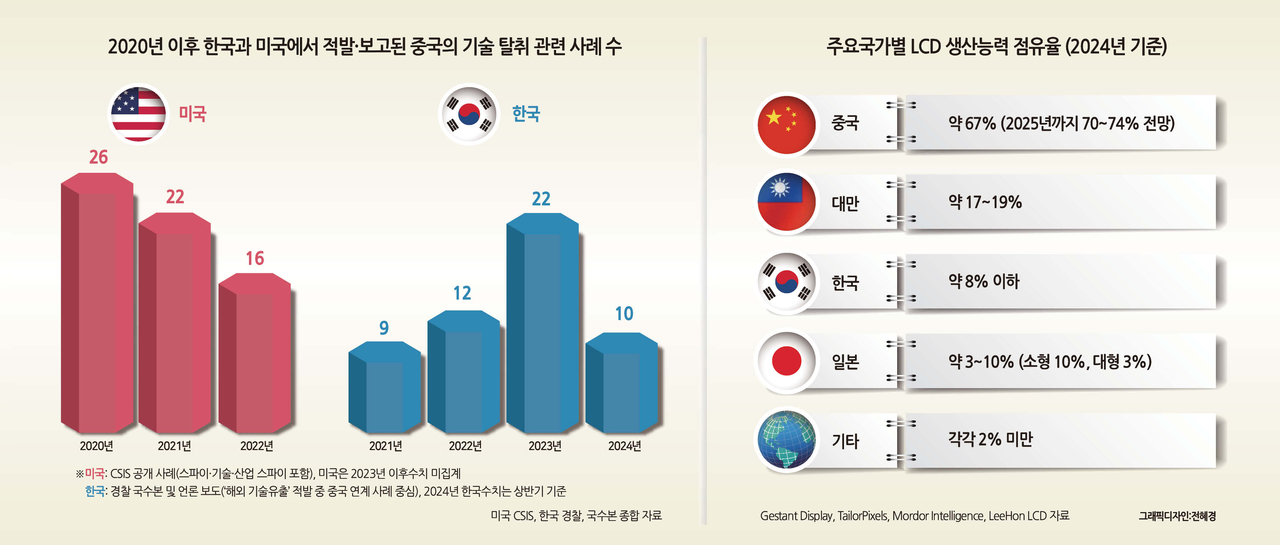
혁신적인 돌파구가 없으면 급격한 축소나 몰락으로 이어질 위험이 크다. 한국의 디스플레이 산업은 그 단적인 사례다. 디스플레이는 오늘날 글로벌 디지털 경제의 핵심 인터페이스다. TV, 컴퓨터, 스마트폰을 비롯해 자동차, 의료기기, 냉장고 등 다양한 제품에 쓰인다. 국방에서도 전투기 조종석의 헤드업 디스플레이와 해군 함정의 전투 정보 시스템 같은 장비에 필수적이다. 글로벌 디스플레이 시장은 2024년 1820억 달러 규모에서 2034년에는 3,720억 달러로 두 배 이상 성장할 전망이다. 2004년 세계 LCD 생산에서 중국의 점유율은 0%였지만 현재는 72%에 이르렀다. OLED 역시 2014년 1%에서 2024년 초 50% 이상으로 급등해 한국을 제치고 세계 1위에 올랐다.
중국은 이 산업을 국가 전략의 핵심으로 보고 막대한 보조금을 투입했다. 그 결과 중국 기업들은 인위적으로 낮은 가격으로 시장을 잠식했다. 반면 삼성과 LG처럼 시장 원리에 따라 수익을 내야 하는 기업들은 불리한 위치에 놓였다. LCD 분야에서 일본 기업들은 2010년 전후로 투자를 중단했고, 많은 외국 기업들은 철수하거나 아예 진입하지 못했다. BOE, TCL, 티안마, 비저녹스 같은 중국 업체들은 후발주자였지만 빠르게 선두 그룹을 따라잡았다.
오늘날 중국 기업들은 단순히 가격 경쟁에만 의존하지 않는다. TCL의 디스플레이 자회사는 2023년 CES에서 ‘올해의 미니LED 디스플레이’ 혁신상을 수상했다. BOE는 세계에서 가장 정교하고 자동화된 공장을 세우며 최근 6년간 세계 특허 출원 상위 10위권에 올랐다. 그러나 이들의 성장은 불공정한 지원에 크게 의존한다. BOE는 2010년부터 2021년까지 약 40억 달러의 보조금을 받았고, 2023년에는 5억 3200만 달러를 지원받아 그 해 순이익 3억5000만 달러를 웃돌았다. 세금 감면, 저금리 자본, 무상 또는 저가 토지와 공공요금, 외국 인재 영입 지원 등 각종 혜택도 뒤따랐다. 일부 지방정부는 신규 공장 건설비용의 85%를 부담하기도 했다.
중국은 지식재산권 탈취로도 이익을 누렸다. 2023년 한국 대법원은 디스플레이 부품업체 톱텍의 임직원들이 BOE에 핵심 기술을 유출한 사건을 유죄로 확정했다. 2024년에는 전직 삼성 엔지니어가 2450만 달러 상당의 기술을 넘긴 혐의로 징역 6년을 선고받았다. 미국 국제무역위원회(ITC)도 중국산 일부 디스플레이가 삼성디스플레이의 AMOLED 특허를 침해했다고 판정했다. 최근에는 BOE가 삼성의 영업비밀을 도용해 OLED 제품을 만들었다는 결론이 내려졌다.
그렇다면 삼성 같은 기업들은 왜 세계무역기구(WTO)에 제소하지 않을까. WTO는 보조금과 지식재산권 침해 사건에서 실적이 부진하다. 판정에 수년이 걸리고, 승소하더라도 집행력이 약해 중국이 계속 규칙을 위반할 수 있다. 현재의 글로벌 무역 질서에서는 중국의 ‘혁신 중상주의’에 제재를 가할 수단이 사실상 없다.
이런 현실에서 한국의 이재명 정부가 취할 수 있는 길은 두 가지다. 우선 국내 정책을 강화해야 한다. 과거 효과적이었던 투자세액공제를 부활시키고, OECD 평균에 크게 못 미치는 R&D 세액공제를 대폭 늘려야 한다. 그러나 국내 조치만으로는 한계가 있다. 중국의 압도적인 산업력에 대응하려면 동맹국과의 협력이 불가피하다. 미국은 이미 관세법 337조를 통해 ITC에 지식재산 침해 제품의 수입을 막을 수 있는 제도를 갖추고 있으며, 삼성은 이를 활용해 BOE를 상대로 소송을 진행 중이다. 한국도 공정거래위원회를 통해 유사한 절차를 밟아야 한다.
결국 지속적인 효과는 국제 공조에서 나온다. 미국, 한국, 유럽연합, 일본 등 주요 민주 국가들이 함께 행동해 충분한 시장 규모를 형성해야만 규칙을 지키는 기업들이 생존할 수 있다. 2026년 프랑스에서 열리는 G7 정상회의는 이러한 연대를 구축할 결정적 기회가 될 것이다.

How Not to Lose Korea’s Advanced Industries
Korea is in a war with China for leadership in numerous key advanced industries, including shipbuilding, consumer electronics, semiconductors, automobiles, chemicals, steel, and batteries. Yet it is losing ground as Chinese firms continue to gain global market share while Korean firms cede it. Korea needs stronger domestic policies to shore up its advanced industries, such as restoring a robust investment tax credit and expanding its weak R&D tax credit. But without working with allies, Korea will not win this war. The United States, in particular, can play a pivotal role by limiting imports of Chinese advanced-technology products made through unfair and mercantilist practices.
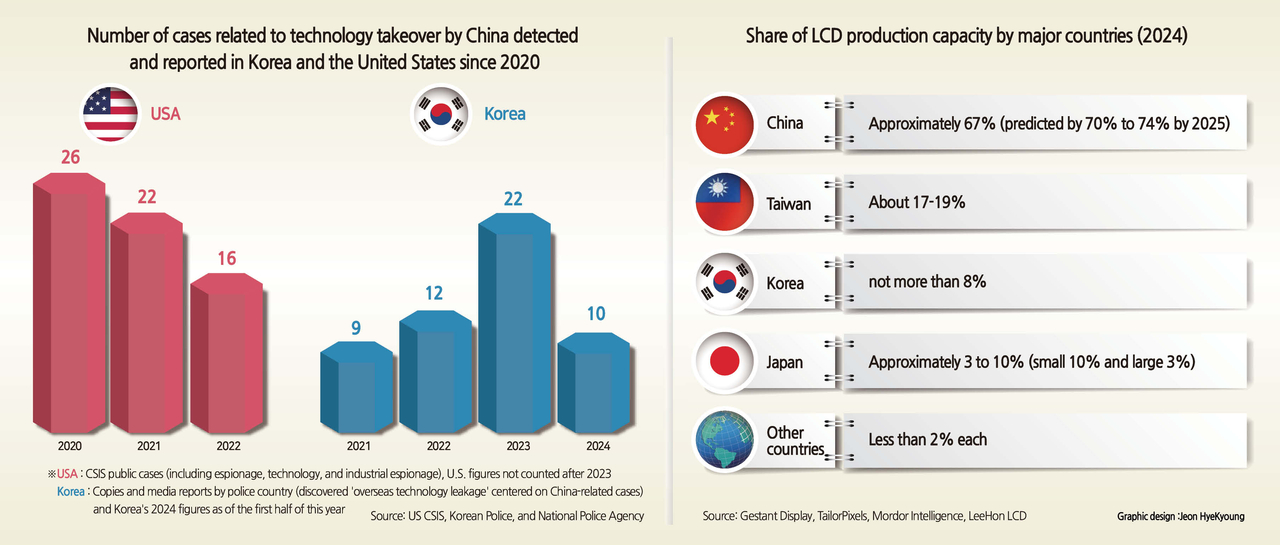
Advanced industries operate differently than most sectors. Scale matters: The larger a producer’s global market share, the lower its cost structure and the more capital it can reinvest in the future. But it works both ways. Once leading firms lose global market share, their marginal costs rise as they continue to carry the burden of high fixed costs like factories and R&D. The result is that future investment declines, competitiveness erodes, and without some remedy, such as a breakthrough innovation, firms risk deep contraction or even collapse. Korea’s display industry offers a cautionary example. Electronic displays have become foundational to the modern global digital economy, representing the key visual and tactile (via touchscreens) human interface for a wide variety of consumer electronics and a range of other applications, including televisions, computers, smartphones, vehicles, medical devices, and even refrigerators. They are also essential to national defense capabilities, from the heads-up displays in fighter jet cockpits to the combat information centers on navy ships. The global display market was valued at $182 billion in 2024 and is projected to more than double to $372 billion market by 2034. Chinese enterprises used to be bit players in an industry dominated largely by Korean firms. In 2004, China’s share of global liquid-crystal display (LCD) production was 0 percent; today it accounts for 72 percent. China’s share of organic light-emitting diode (OLED) production surged from 1 percent in 2014 to more than 50 percent, overtaking South Korean firms for the first time in early 2024 as the leading producer of OLED panels.
Beijing has poured massive government subsidies into its display industry, underscoring the importance of the sector to China’s overall industrial strategy. Those resources have allowed Chinese companies to sell at artificially low prices, flooding the market and making it difficult for foreign competitors-such as Korea’s Samsung and LG, which must earn market-based rates of return-to persist in the industry.
The result of China’s market-distorting approach has been brutal: In the LCD sector, most foreign competitors have either pulled out, Japanese companies stopped investing in the industry altogether around 2010, or decided not to enter the market in the first place. So, while Chinese display makers such as BOE, TCL, Tianma, and Visionox may have started behind top players like LG, Samsung Display, and Japan’s Sharp, they’ve quickly caught up.
Additionally, Chinese display makers are no longer just copycats competing on price. These companies are increasingly developing innovative products in their own right, gaining international recognition and winning prestigious awards. For example, TCL’s display subsidiary,
China Star Optoelectronics Technology, won the Innovation Award for “MiniLED Display of the Year” at the 2023 Consumer Electronics Show. Meanwhile, BOE, the largest Chinese display manufacturer, has built some of the most sophisticated, automated manufacturing facilities in the world and has amassed a massive patent portfolio, ranking among the world’s top 10 patent filers over the past six years.
China has clearly wrested leadership in the LCD industry away from foreign competitors and is poised to do the same in OLED. But its ascent rests heavily on unfair play. In fact, Beijing openly disregards the rules.
BOE received nearly $4 billion in subsidies from 2010 to 2021, averaging $325 million per year. In 2023, it secured $532 million in subsidies, far exceeding its $350 million profit that year. In addition to loans and grants, state support for Chinese display manufacturers takes many forms: tax breaks, discounted capital, free or low-cost land and utilities, and state-backed financing to hire foreign talent. Local governments, for instance, sometimes cover as much as 85 percent of the cost of new display facilities.
Chinese display producers have also benefited from extensive foreign intellectual property (IP) theft. In July 2023, Korea’s Supreme Court convicted executives and employees at Toptec, a key input supplier to the display industry, of leaking key technological assets to BOE. In July 2024, a former Samsung engineer was sentenced to six years in a South Korean prison for leaking $24.5 million worth of display technology secrets to China. Last year, a U.S. International Trade Commission (ITC) administrative law judge ruled that certain Chinese displays infringed Samsung Display’s U.S. patents relating to innovations in active-matrix organic light-emitting diode (AMOLED) display technology. And now another ITC judge has determined that BOE stole trade secrets from Samsung to make OLED display products.
So why don’t Samsung and other firms take these grievances to the World Trade Organization (WTO)? There are many reasons. To start, the WTO has a poor track record of prosecuting domestic subsidy and IP theft cases. Getting a positive ruling can take years, and even if a company wins, enforcement is often weak, meaning Chinese firms could simply continue to break the rules. As the global trading system is currently structured, there is no way to penalize China for its “innovation mercantilist practices.” The truth is simple: Beijing refuses to play by the rules.
That reality leaves the new Lee Jae-myung administration with two paths, both of which it should pursue. First, Seoul must strengthen its advanced-industry support policies, including those for the display sector. Korea once had an effective investment tax credit for new factories and equipment, which should be reinstated. Additionally, Korea’s R&D tax credit lags far behind the OECD average. The Lee administration and the National Assembly should quadruple it to bring Korea in line with peer nations.
These domestic measures are necessary, but they will not suffice alone. The Korean government is not large enough to counter China’s massive industrial power. It must work with allies facing similar challenges to restrict imports of Chinese goods produced through unfair means. The United States already has a legal and institutional mechanism for this: Section 337 of the U.S. Tariff Act, which empowers companies to bring cases before ITC administrative law judges to block imports tied to IP theft and other mercantilist practices. Samsung is currently pursuing such a case against BOE, asserting IP theft. Korea does as well, through its Korean Trade Commission. It should open a similar investigation into BOE.
Ultimately, lasting impact will require a coordinated front. Exclusion orders will only work if the United States, Korea, the European Union, Japan, and all other advanced, democratic allies participate and adopt parallel measures. Only a coalition representing a large enough share of global market demand can ensure that firms obeying the rules survive. Building this cooperative effort should be a top priority for the 2026 G7 summit in France.
bonsang@heraldcorp.com


![대기업 다닌다고 5억 더 받는 ‘사내대출’ 정부도 못 건드리는 ‘무적’일까 [Deep Spot]](https://wimg.heraldcorp.com/news/cms/2026/10/25/rcv.YNA.20260630.PYH2026063010730006100_T1.jpg?type=h&h=640)
![“협연자가 다쳤습니다”…위기의 순간, 오케스트라는 누구에게 전화할까? [백스테이지]](https://wimg.heraldcorp.com/news/cms/2026/10/24/news-p.v1.20260520.49d11745c1ce4d41aa339675ab78c59d_T1.jpg?type=h&h=240)
![수지·분당 거쳐 반포 자가 20대 부부, 부모찬스 1.5억…나머지는 어떻게? [월급 모아 반포까지①]](https://wimg.heraldcorp.com/news/cms/2026/10/24/news-p.v1.20260802.89fcfaf00b734702afbf28a2d721e32b_T1.jpg?type=h&h=240)
![[美중간선거 10문10답] 공화 텃밭도 요동…트럼프 31% 최악 지지율 상·하원 뒤집힐까 [딥스폿]](https://wimg.heraldcorp.com/news/cms/2026/10/24/rcv.YNA.20261021.PRU20261021179201009_T1.jpg?type=h&h=240)