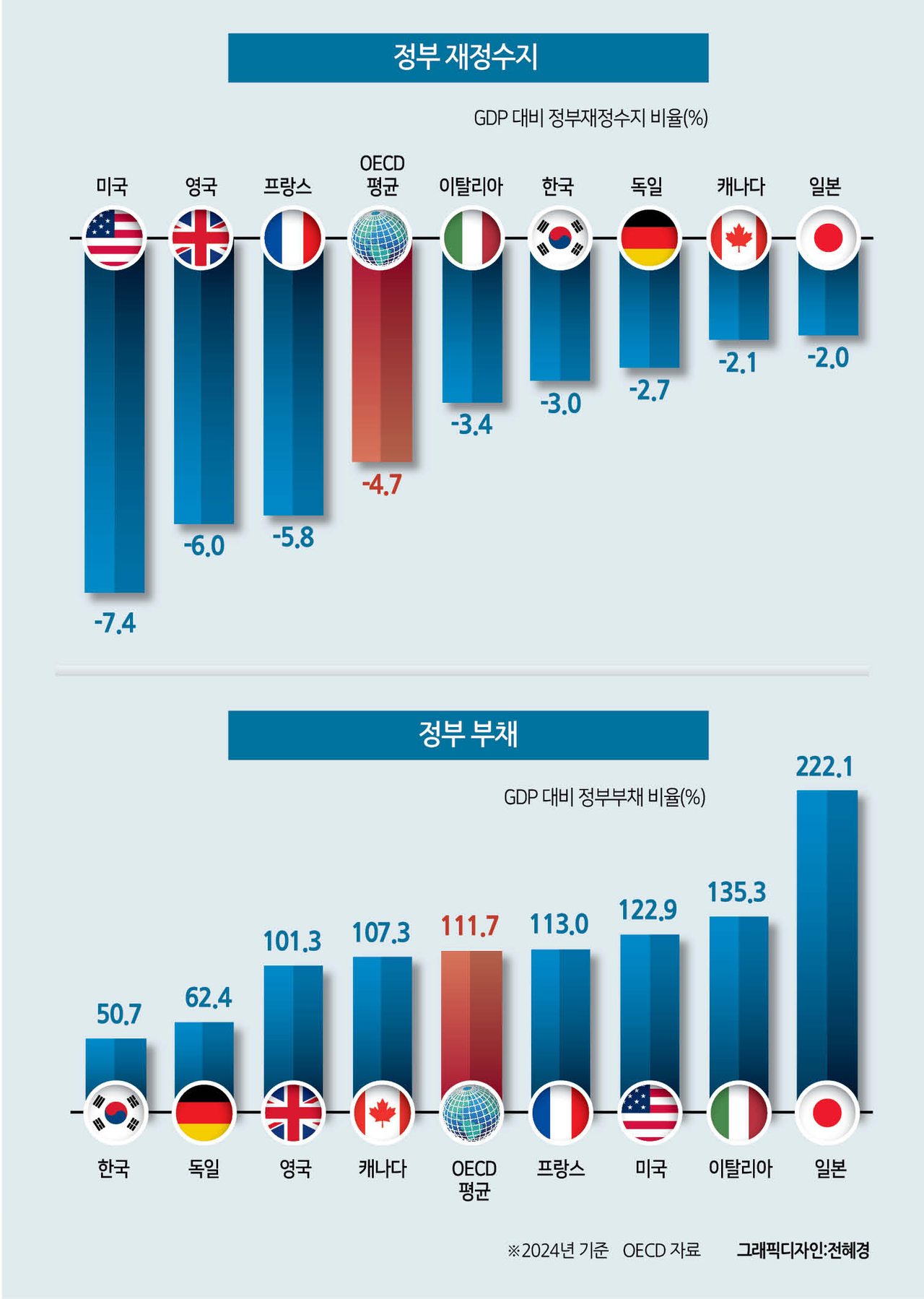

지난 수십 년 동안 대부분의 OECD 국가에서 정부 부채가 뚜렷하게 증가해 왔다.
2024년에는 GDP 대비 평균 110%를 넘어섰다. 이는 글로벌 금융위기(GFC) 이전인 2007년 수준보다 거의 40%포인트 높은 수치다. 주요 7개 OECD 경제권 중 정부 부채는 독일이 GDP의 62%로 가장 낮고, 일본은 222%로 가장 높았다. 한국의 정부 부채는 GDP의 50%를 약간 웃돌았다. 모든 주요국은 여전히 재정적자를 기록하고 있으며, 2024년 기준으로 일본은 GDP의 2%, 미국은 7% 이상, 한국은 3% 수준이다. 부채는 GFC와 코로나19 팬데믹 기간 동안 급격히 증가했으며, 대부분의 정부는 경기 확장기에도 부채 비율을 유의미하게 줄이지 못했다. GFC 이후 10년간 지속된 초저금리 환경은 대부분 국가에서 부채 부담을 완화했지만, 동시에 재정 적자 축소에 대한 유인을 약화시켰다.
그러나 최근 몇 년간 금리가 상승하고 지정학적 긴장 속에서 경제 성장 전망이 불확실해지면서, 많은 정부가 특히 유럽에서 국방비 지출 확대를 약속했다. 영국과 미국을 포함한 주요 경제국에서는 국채 시장 불안이 나타났으며, 프랑스는 의회 다수당의 부재로 인해 GDP의 5%를 넘는 재정적자를 줄이기 위한 예산을 통과시키지 못하면서 국채 수익률이 상승하고 신용등급이 하향 조정됐다. 금리 상승과 경제·정치적 불확실성 심화로 인해 OECD 주요국에서는 재정 지속가능성이 정책 논의의 핵심 의제로 다시 부각했다.
이 문제는 특히 유럽에서 두드러진다. 2010년대 초 정부 부채 위기의 상흔이 여전히 남아 있기 때문이다. 현재 유로 지역의 금융 상황은 2011~2012년 그리스, 포르투갈, 아일랜드의 10년물 국채 스프레드가 각각 독일 대비 약 33, 12, 10%포인트에 달했던 시기와는 거리가 멀다. 10월 28일 기준으로 프랑스와 이탈리아의 10년물 국채 스프레드는 독일 대비 약 0.8%포인트로, 유로 지역에서 가장 높았다. 과거 유로 주권 부채 위기국들은 대규모 경상수지 적자를 기록했지만, 현재 프랑스는 수출 성과가 팬데믹 이전보다 악화했음에도 불구하고 경상수지가 대체로 균형을 이루고 있다. 또한 마리오 드라기 당시 유럽중앙은행(ECB) 총재가 2012년 “유로를 지키기 위해 필요한 모든 조치를 하겠다(whatever it takes)”고 발언한 이후, 통화동맹 내 위기 대응 메커니즘이 상당히 강화됐다. 유로 지역의 여러 국가들이 구조 개혁을 통해 재정 건전성과 경쟁력을 개선함으로써, 위기 확산 위험이 제한됐다.
그럼에도 불구하고 안심할 여지는 없다. 정부 부채가 위험한 수준에 이르는 임계점을 정하는 것은 어렵고, 그 수준은 국가마다 다르다. 일본은 풍부한 국내 저축이 정부 채권으로 유입되고 비전통적 통화정책이 시행된 덕분에, GDP의 200%가 넘는 총부채를 비교적 낮은 비용으로 감당하고 있다.
반면 유로 지역의 주변국들은 훨씬 낮은 부채 수준에서도 재정이 지속 불가능해졌고, “트로이카”(유럽연합 집행위원회, 유럽중앙은행, 국제통화기금)의 구제금융과 혹독한 조정 프로그램을 받아야 했다. 어떤 경우든, 높은 부채는 투자자들이 신뢰를 잃고 금리를 끌어올릴 위험을 키우며, 경기 충격에 대한 정책 대응력을 약화시켜 경기침체와 금융 불안을 악화시킬 수 있다.
![찢어진 유럽연합(EU) 깃발이 유로 지폐 위에 놓여 있다. [로이터]](https://wimg.heraldcorp.com/news/cms/2025/11/11/news-p.v1.20251029.852de2c744814e39861efef62c6fa73a_P1.jpeg)
정책적 대응이 없다면, 대부분의 OECD 국가에서 정부 부채는 더 증가할 것이다. 인구 고령화로 연금, 보건, 장기요양 지출이 늘어나기 때문이다. OECD 장기 전망에 따르면, 이러한 지출은 2060년까지 OECD 평균에서 GDP 대비 약 4%포인트 증가할 수 있으며, 한국은 이보다 두 배 가까이 늘어날 가능성이 있다. 한국은 65세 이상 인구 비중이 가장 빠르게 늘어나는 나라 중 하나다. 지정학적 긴장 속에서 국방비 지출 증가도 많은 국가의 재정을 추가로 압박할 것이다.
부채의 추이는 금리와 경제성장의 변화에 크게 영향을 받는다. 순이자 지급을 제외한 기초 재정수지가 일정할 때, 금리가 GDP 성장률보다 높으면 부채가 늘고, 그 반대면 감소한다. 미래 금리를 예측하기는 어렵지만, GFC 이후 이어진 초저금리 시대는 끝난 것으로 보인다. 10년물과 30년물 국채 수익률 차이나 10년 후의 실질금리 같은 시장 기반 지표들은 향후 더 높은 금리를 예상하고 있다. 한편, 향후 수십 년 동안 생산가능인구 증가세는 둔화하거나, 일본·한국·유럽의 절반 이상 OECD 국가에서 감소할 것이다. 이는 잠재성장을 낮출 것이다. 인공지능(AI)의 확산으로 생산성이 높아질 가능성도 있지만, 연구마다 추정치가 크게 다르고, 무역 장벽과 불확실성 증대는 생산성 향상을 저해할 수 있다. GDP 성장이 강할수록 부채 감축에 도움이 된다. OECD의 최근 연구에 따르면, 1970년대 이후 OECD 국가의 공공부채 감축 사례 대부분은 성장의 역할이 컸다. 정부는 성장을 촉진하는 개혁을 추진해야 하지만, 불확실성을 감안할 때 재정계획에 낙관적 성장 전망을 과도하게 반영해서는 안 된다.
정부 부채 증가가 피할 수 없는 일만은 아니다. OECD 국가 중 에스토니아는 2024년 기준으로 GDP 대비 정부 부채가 24% 미만으로 가장 낮다. 덴마크와 스웨덴의 정부 부채 비율은 각각 1993년 84%, 1996년 69%에서 현재 30%대 초반까지 하락했다. 이는 재정책임에 대한 강한 의지가 공공부채를 줄이는 데 얼마나 효과적인지를 보여준다. 스칸디나비아 국가들은 효율적인 복지국가이자 세계에서 가장 행복한 나라로 꼽히며, 재정 규율이 높은 사회적 비용을 수반할 필요는 없음을 보여준다. 또한 이들 국가의 조세 및 사회보장 기여금의 GDP 대비 비율은 정부 부채가 정점에 달했을 때보다 지금이 더 낮다. 정부 부채의 변화를 좌우하는 요인은 다양하다. 연금비용을 억제하기 위한 근로수명 연장, 전 연령층의 높은 고용 유지, 생산성 제고, 보건 및 장기요양 지출의 효율화 등이 모두 중요하다.
탄탄한 재정 프레임워크는 재정정책이 경제 상황에 대응하면서도 지속 가능하도록 보장한다. 수요가 약한 시기에는 재정적자가 경기 위축과 고용 감소를 완화하며, 경기 확장기에는 재정 여력을 회복해야 한다. 경기 순환에 맞춘 유연한 재정규칙(예: 매년이 아닌 경기 주기별 재정적자 한도)은 정책 대응성을 높이지만, 더 엄격한 규칙보다 실행이 어렵다. OECD 다수 국가는 재정 및 경제정책에 대한 독립적인 감시기구를 설치했다. 예를 들어 덴마크 경제위원회와 스웨덴 재정정책위원회는 재정 모니터링과 정책 분석에서 중요한 역할을 한다. 한국의 정부 부채는 OECD 평균보다 여전히 낮지만 최근 빠르게 증가하고 있으며, 급속한 고령화로 인해 상승 압력이 커질 것이다. 한국의 재정 프레임워크를 강화하면 부채 억제에 도움이 될 것이다.
보다 일반적으로 OECD 전역에서 정부는 신중한 재정정책을 유지해야 한다. 인구 고령화로 인한 지출 압박이 커지고, 금리와 성장 전망의 불확실성이 높아졌으며, 기후변화로 인한 재해 위험이 커지고 있다. 경제 분절화는 경기 충격의 가능성을 높이고, 정치적 양극화는 재정적자 확대 시 교정 조치를 어렵게 만들어 시장의 부정적 반응을 초래할 수 있다.
※이 칼럼에서 표현된 견해는 저자의 개인적인 의견이며, OECD나 그 회원국들의 견해를 나타내는 것은 아닙니다.”
The rise in government debt in OECD countries must be contained
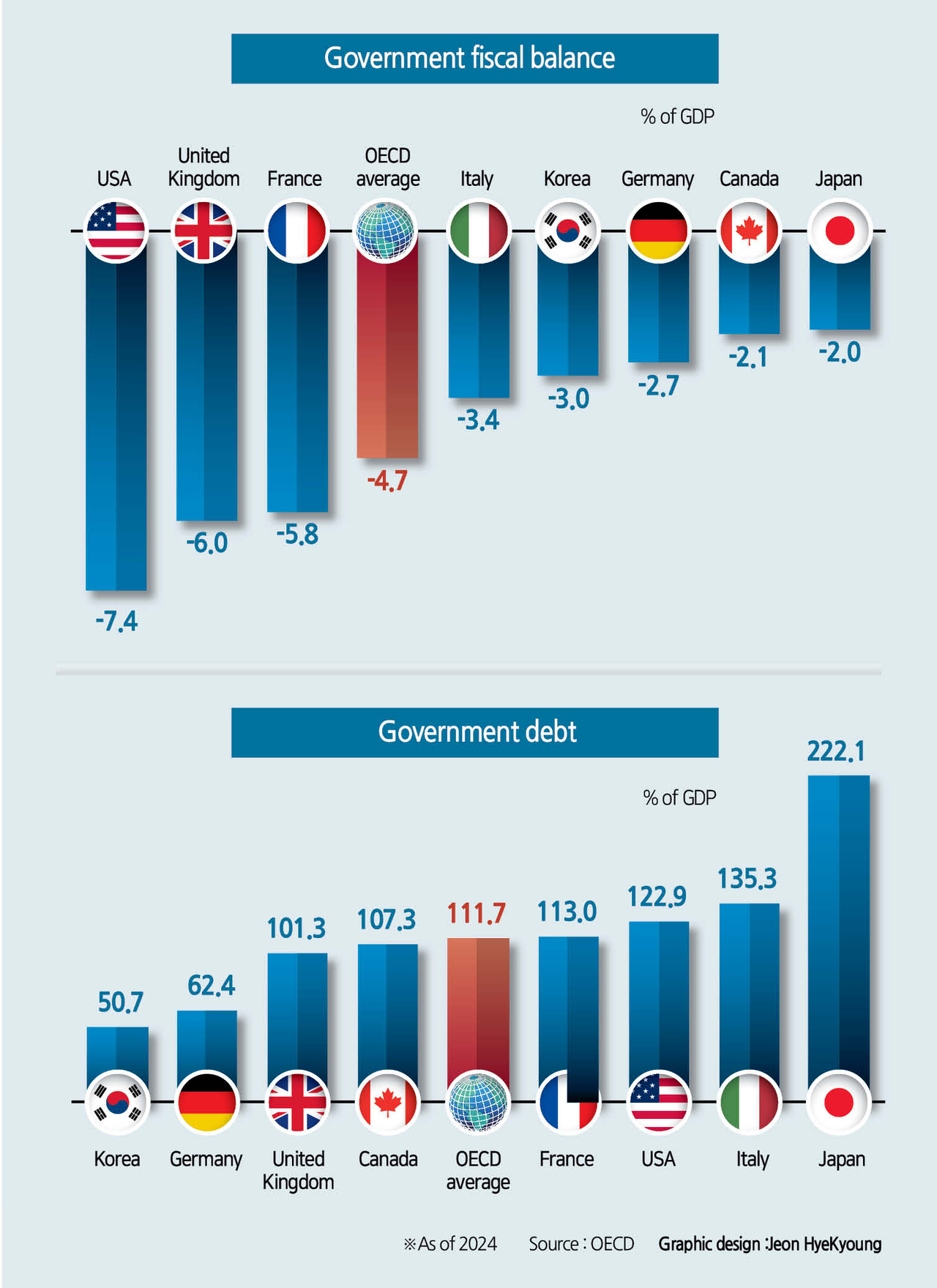
Government debt has risen markedly in most OECD countries over the past decades, reaching an average of more than 110% of GDP in 2024, nearly 40 percentage points above its 2007 level, prior to the global financial crisis (GFC). Within the seven major OECD economies, government debt ranged from 62% of GDP in Germany to 222% of GDP in Japan. In Korea, it slightly exceeded 50% of GDP. All big countries continue running budget deficits, from 2% of GDP in Japan to more than 7% of GDP in the United States, with Korea at 3% of GDP in 2024. Debt increased sharply during the GFC and the COVID-19 pandemic,and most governments failed to reduce significantly their debt ratios during economic expansions. Very low interest rates in the decade following the GFC alleviated the debt burden in most countries, substantially weakening incentives to reduce deficits.
However, over the past few years interest rates have risen, economic growth prospects have become more uncertain amid geopolitical tensions, and many governments have pledged to spend more on defence, especially in Europe. Several major economies have experienced bouts of tension in their government bond markets, including the United Kingdom and the United States. French government bond yields have risen and credit ratings have been downgraded, as the absence of a parliamentary majority hampers the adoption of a budget that would lower the government deficit from a level that exceeds 5% of GDP. With higher interest rates and heightened economic and political uncertainty, fiscal sustainability has forcefully reemerged in the policy debate in many OECD countries.
This is particularly the case in Europe, where the sovereign debt crisis of the early 2010shas left durable scars, even though the current financial situation in the euro area is nowhere near that of 2011-12, when Greek, Portuguese and Irish 10-year government bond spreads vis-à-vis Germany peaked at about 33, 12 and 10 percentage points respectively. As of October 28th , France, along with Italy, had the euro area’s highest 10-year government bond spreads with Germany, at around 0.8 percentage points. Countries involved in the euro sovereign debt crisis in the past decade then ran large external deficits, contrasting with France’s roughly balanced current account today, despite a deterioration in export performance compared to the pre-pandemic period. Furthermore, following Mario Draghi’s July 2012 speech in which he stated that the European Central Bank was ready to do “whatever it takes” to preserve the euro, mechanisms to deal with crises within the currency union have been considerably strengthened. In addition, structural reforms in several euro area countries have improved their fiscal positions and competitiveness, limiting contagion risks.
Nevertheless, there is no room for complacency. Defining a threshold at which government debt becomes dangerous is challenging and such a level would vary across countries. Japan has so far been able to finance a gross government debt of over 200% of GDP at a relatively low cost, thanks to abundant domestic savings flowing into government bonds and unconventional monetary policy, while lower debt levels proved unsustainable in euro area peripheral countries, which had to be bailed out by the “Troika” (European Commission, European Central Bank and International Monetary Fund) and implement tough adjustment programmes. In any case, high debt increases the risk that investors lose confidence and push up interest rates, and may also hamper policy responses to economic shocks, worsening recessions and financial stress.

Without policy action, government debt is set to rise further in most OECD countries, as population ageing pushes up pension, health and long-term care spending, which according to OECD long-term projections could increase by nearly four percentage points of GDP on average in the OECD by 2060, and about twice as much in Korea, which will experience the fastest rise in the share of the population aged 65 or over. Potential increases in defence spending, as geopolitical tensions mount, could further strain public finances in many countries.
Debt dynamics are crucially affected by developments in interest rates and output growth. For a given primary budget balance, which excludes net interest payments, debt increases if interest rates are higher than GDP growth and decreases in the opposite case. Although forecasting future interest rates is challenging, the long period of extremely low interest rates that followed the GFC seems over. Market-based indicators, such as yield spreads between 10-year and 30-year sovereign bonds, or 10-year forward real interest rates in 10 years, point to expectations of higher interest rates in the future. Meanwhile, the working-age population will grow more slowly over the coming decades and even shrink in more than half of OECD countries, including Japan, Korea and many European countries. This will pull down potential growth. Demographic headwinds could be partly offset by higher productivity growth, especially thanks to the diffusion of artificial intelligence (AI). However, estimates of AI-related gains vary widely across studies and other factors, like rising obstacles to trade and heightened uncertainty may weigh on productivity growth. Stronger GDP growth would help reduce debt. Recent OECD research shows that growth has played a major role in almost all public debt reduction episodes in OECD countries since the 1970s. Governments should promote growth-enhancing reforms, while remaining prudent about growth projections embedded in fiscal plans given the uncertainties involved.
The rise in government debt is not inevitable. Among OECD countries, Estonia has the lowest government debt-to-GDP ratio, below 24% in 2024. Denmark and Sweden’s government debt ratios are now only slightly above 30%, after peaking around respectively 84% (in 1993) and 69% (in 1996), illustrating the potential of a strong commitment to fiscal responsibility to bring down public debt. The Scandinavian countries are efficient welfare states, ranking among the world’s happiest countries, showing that fiscal discipline does not need to come at a high social cost. Moreover, the ratio of tax and social contributions to GDP in these countries is now lower than when government debt ratios peaked. Many factors influence government debt developments. Lengthening working lives is crucial to contain pension costs and fostering high employment in all age groups can support economic growth and government revenue, particularly in ageing societies. High productivity can generate additional resources. Efficiency gains can help contain public expenditure, including on health and long-term care.
A solid fiscal framework helps ensure that fiscal policy is both sustainable and responsive to economic conditions. Budget deficits can stimulate the economy in case of weak demand, limiting contractions in output and employment, mitigating scarring effects on the economy. However, fiscal buffers should be restored during expansions. Flexible fiscal rules, such as budget deficit caps over the business cycle rather than every year, allow policy responsiveness. But they are also more difficult than more rigid rules to implement. Many OECD countries have put in place independent fiscal “watchdogs” to inform fiscal and economic policy. For example, the Danish Economic Council and the Swedish Fiscal Policy Council play an important role in fiscal monitoring and policy analysis. While Korea’s government debt remains relatively low by OECD standards, it has grown rapidly in recent years and rapid ageing will increase upward pressure. Strengthening the Korean fiscal framework would facilitate debt containment.
More generally, across the OECD, governments need to pursue prudent fiscal policies, as spending pressure from population ageing is rising, uncertainty about interest rates and growth prospects has increased, climate change heightens the risk of costly natural disasters, economic fragmentation increases the probability of economic shocks and growing political polarisation in many countries may hamper corrective action in case of deficit drift, triggering adverse market reactions.
The views expressed in this column are those of the author and not of the OECD or of its member countries.
bonsang@heraldcorp.com


![임영웅 51억에 산 집, 이젠 120억…하하·정동원도 사는 ‘강북판 타워팰리스’[초고가 주택 그들이 사는 세상]](https://wimg.heraldcorp.com/news/cms/2026/10/17/news-p.v1.20261016.f574b812626d48019a4018618b827c5b_T1.jpg?type=h&h=640)
![“샌디스크도 아니었다”…S&P500 상승률 1위, 7배 뛴 이 종목[서학개미 주식회사]](https://wimg.heraldcorp.com/news/cms/2026/10/15/news-p.v1.20251010.236fb20db3324e3bbd6f1dba7ec63bff_T1.jpg?type=h&h=240)
![[르포] 공장 들어서자 ‘밥 냄새’가 훅…쿠첸 ‘티타늄 밥솥’ 의 비밀[그 회사 어때?]](https://wimg.heraldcorp.com/news/cms/2026/10/16/news-p.v1.20260923.16e9b0f48f08469fa1014f2864f8e8fc_T1.jpg?type=h&h=240)
![장기금리와 그린스펀의 수수께끼…이번엔 뒤집혔다 [지안루카 베니그노]](https://wimg.heraldcorp.com/news/cms/2026/10/14/news-p.v1.20261012.37af49395c5e42388798ef9d8de6e08b_T1.jpg?type=h&h=240)