![일본 도쿄에 있는 일본중앙은행 건물 위에 일장기가 펄럭이고 있다. [로이터]](https://wimg.heraldcorp.com/news/cms/2026/09/01/news-p.v1.20260816.209013b3297d4c92ab32710d529f3877_P1.jpg)

명목 앵커란 무엇인가
화폐 그 자체에는 실질적인 가치가 거의 없다. 화폐의 가치가 안정적으로 유지되려면 어떤 방식으로든 일정한 기준점에 묶여 있어야 한다. 경제학자들은 이러한 기준점을 ‘명목 앵커(nominal anchor)’라고 부른다.
금본위제에서는 화폐의 환율을 금에 고정함으로써 화폐 가치를 안정시켰다. 제2차 세계대전 이후 만들어진 브레턴우즈 체제도 같은 원리에 기반했다. 달러 가치를 금에 연동하고, 다른 통화의 가치를 달러에 연동하는 방식이었다.
변동환율제로 전환되고 1970년대 높은 인플레이션을 겪은 이후 많은 나라가 새로운 명목 앵커를 도입했다. 바로 인플레이션 타깃팅(inflation targeting·물가안정목표제)이다. 중앙은행이 가령 2%라는 물가상승률 목표를 제시하고, 물가가 목표치를 웃돌면 통화정책을 긴축하고 목표치를 밑돌면 완화하는 방식이다. 이런 정책이 반복되면 사람들은 물가상승률이 결국 목표 수준으로 돌아올 것이라고 믿게 된다.이러한 믿음 자체가 물가를 안정시키는 데 도움을 준다. 일본이 2% 물가안정 목표를 도입한 것은 비교적 최근인 2013년 1월이다. 그렇다면 그전까지 일본에는 명목 앵커가 없었던 것일까. 아마 그렇지는 않았을 것이다.
사실상의 앵커였던 ‘0%’
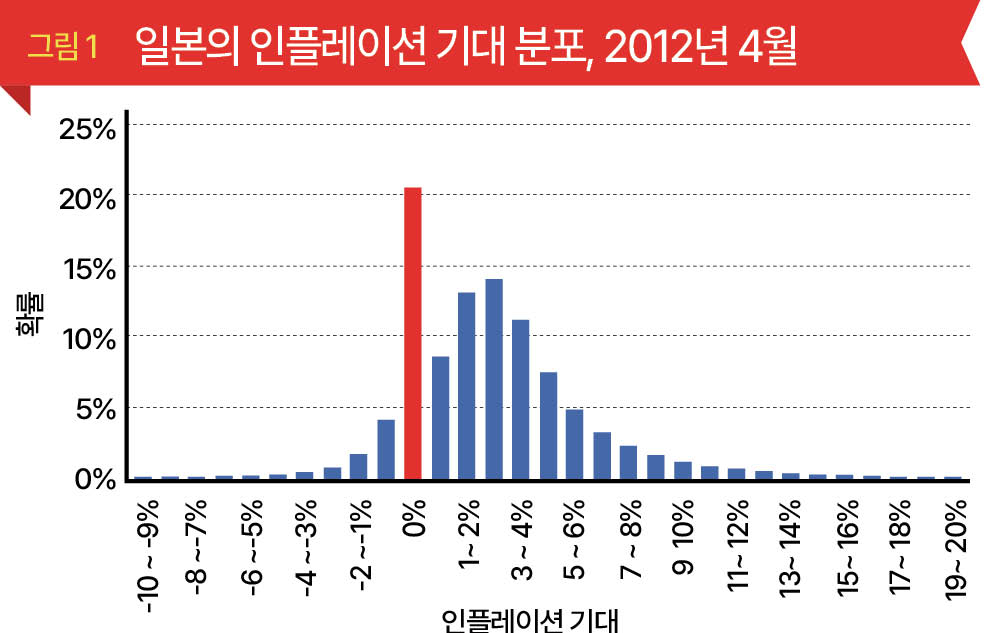
<그림 1>은 일본 내각부의 소비자심리조사를 바탕으로 추정한 2012년 4월 일본 가계의 물가상승률 기대 분포를 보여준다. 많은 응답자가 향후 1년 동안 물가가 2~3% 오를 것으로 예상했다. 하지만 더욱 눈에 띄는 것은 0%에 집중된 응답이었다. 물가가 그대로일 것으로 예상한 사람들이 많았던 것이다. 0%는 분포에서 뚜렷하고도 높은 봉우리를 형성했다.
이는 당시 가계의 인플레이션 기대가 0%에 강하게 고정돼 있었음을 시사한다. 일본은행(BOJ)이 공식적으로 물가상승률 0%를 약속한 적은 없었다. 그러나 1990년대 중반부터 오랫동안 물가가 거의 오르지 않으면서 ‘물가는 오르지 않는다’는 믿음이 가계와 기업의 의식 속에 깊이 자리 잡았다.
이러한 0% 앵커는 명목 앵커 역할을 하면서 물가 안정에 기여했던 것으로 보인다. 예를 들어 일본 경제가 외부의 인플레이션 충격을 받았다고 가정해보자. 가계와 기업의 인플레이션 기대가 0%에 가까운 수준을 유지한다면, 충격이 임금과 가격 결정에 연쇄적으로 반영될 가능성은 낮아진다. 일시적인 충격이 지속적인 인플레이션으로 번질 위험도 그만큼 줄어든다.
비전통적 통화완화에도 살아남은 0% 앵커
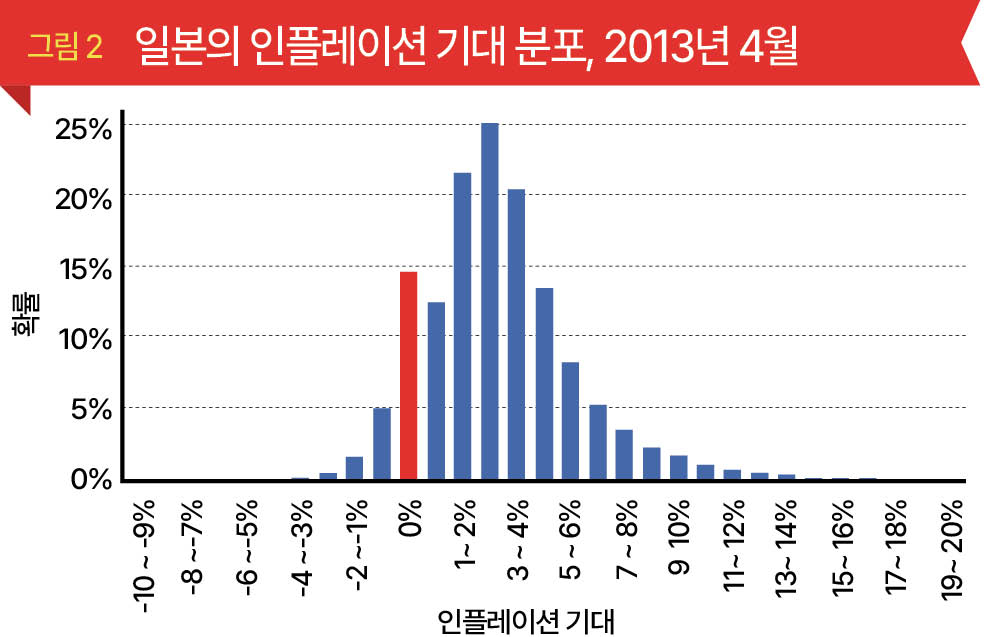
그렇다면 인플레이션 타깃팅이 도입된 이후에는 어떤 일이 벌어졌을까. <그림 2>는 새로운 인플레이션 목표가 도입되고 구로다 하루히코 총재가 이끄는 일본은행이 전례 없는 통화완화 프로그램을 시작한 2013년 4월의 분포를 보여준다.
1년 전과 비교하면 0%에 집중된 정도가 확실히 약해졌다. 구로다 총재의 강력한 디플레이션 탈출 의지와 공격적인 양적완화가 가계의 인플레이션 기대를 변화시켰을 가능성을 보여준다. 그러나 이후 0% 앵커가 계속해서 약해진 것은 아니었다.
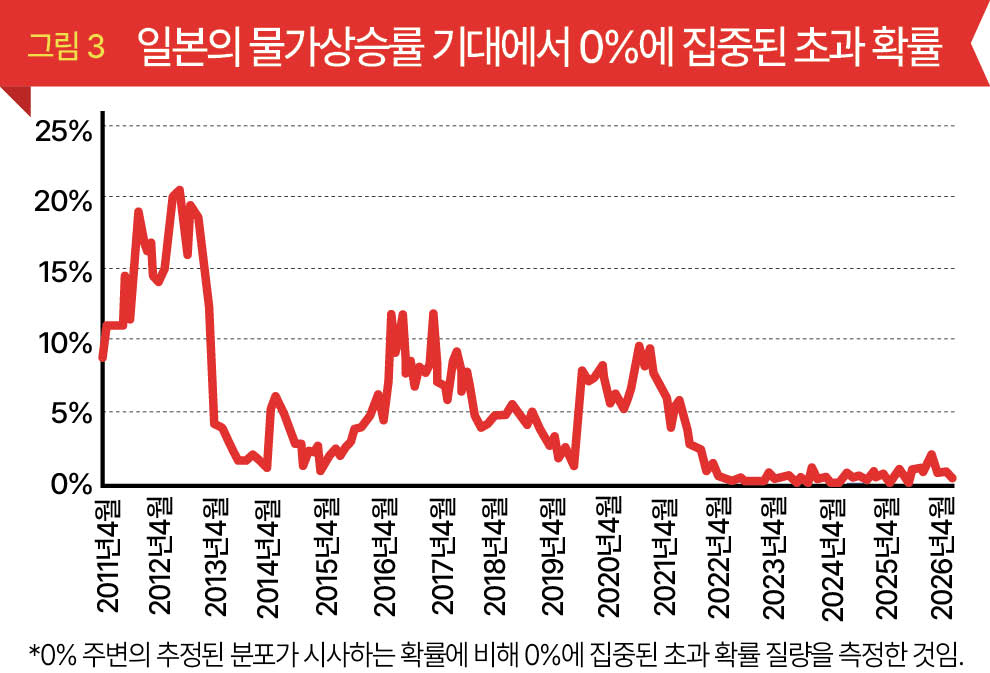
<그림 3>은 시점별로 0%에서 나타나는 초과 확률 질량(excess probability mass)을 측정한다. 구체적으로는 실제 0%에서 관측된 확률이 0% 주변의 추정 분포를 통해 산출된 확률보다 얼마나 높은지를 보여주는 지표다.
이 지표는 2013년 봄 크게 떨어졌지만 이후 다시 상승했다. 인플레이션 목표를 도입하기 전 수준까지 돌아가지는 않았지만, ‘물가는 오르지 않는다’는 믿음은 일본은행의 비전통적 통화완화가 시행되는 동안에도 여전히 뿌리 깊게 남아 있었다.
구로다 총재는 2023년 퇴임하면서 일본의 오랜 디플레이션 경험이 임금과 물가가 오르지 않을 것이라는 가정에 기반한 사고방식과 관행, 즉 깊이 뿌리내린 ‘규범(norms)’을 만들어냈다고 회고했다. 그리고 이러한 규범이 일본은행이 2% 목표를 지속적이고 안정적으로 달성하는 데 걸림돌이 됐다고 평가했다. 이 ‘규범’은 내가 말하는 0% 앵커와 상당 부분 겹친다.
앞서 살펴봤듯이 0% 앵커는 물가 안정에 기여했다. 그러나 일본은행이 디플레이션을 끝내려 하자 바로 그 앵커가 통화정책의 장애물이 됐다.
인플레이션 기대가 외부의 인플레이션 압력에 쉽게 흔들리지 않도록 만든 바로 그 특성이, 일본은행이 통화완화를 통해 인플레이션 기대를 끌어올리려는 시도에도 기대가 쉽게 움직이지 않도록 만들었던 것이다.
일반적으로 중앙은행이 앞으로도 통화완화 기조를 계속 유지하겠다는 신뢰할 만한 의지를 보이면 사람들은 더 높은 인플레이션을 예상하게 될 수 있다. 이러한 기대 변화는 다시 현재의 인플레이션을 끌어올릴 수 있다.
하지만 0% 앵커가 강하게 작동하는 상황에서는 사람들은 결국 물가가 오르지 않을 것이라고 계속 믿는다. 이런 환경에서는 통화완화를 장기간 지속하겠다는 약속조차 인플레이션 기대를 충분히 끌어올리지 못할 수 있다. 그 결과 현재의 물가상승률에 미치는 효과 역시 약해진다.
2022년 이후 0% 앵커는 사실상 사라졌다
상황은 2021년 이후 크게 달라지기 시작했다. <그림 3>에서 보듯 코로나19 팬데믹이 시작된 뒤 한동안 0%에 대한 집중도가 높아졌다. 그러나 2021년 봄부터 하락하기 시작했고, 2022년 봄 이후에는 매우 낮은 수준을 유지하고 있다.
2022년 봄은 일본이 현재의 인플레이션 국면에 진입한 시점이기도 하다. 기업들은 광범위한 상품과 서비스에 걸쳐 높아진 비용을 가격에 전가하기 시작했다.
기업들이 가격을 올리려는 의지가 커진 것은 단순히 원재료 등 투입 비용이 상승했기 때문만은 아니다. 소비자들이 가격 인상을 받아들일 것이라는 기업들의 인식이 달라진 것도 중요한 요인이었다.
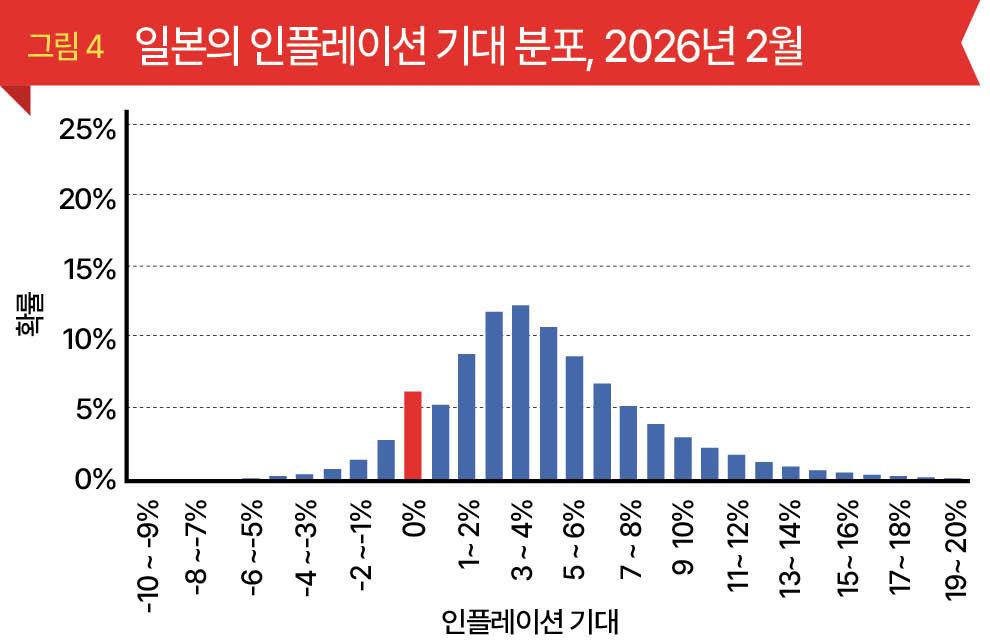
<그림 4>는 이란 전쟁이 발발하기 직전인 2026년 2월 일본의 인플레이션 기대 분포를 보여준다. 2012년에 뚜렷하게 나타났던 0%의 봉우리가 거의 사라졌다. 이는 이제 0%에서 이탈하는 현상이 상당히 진전됐음을 의미한다. 그렇다고 0%에 대한 집중이 완전히 사라진 것은 아니다. 연령대별로 보면 젊은 가계일수록 여전히 물가상승률이 0%에 머물 것으로 예상할 가능성이 높다.
일본의 장기 디플레이션 시기에 성장기를 보낸 젊은 세대일수록 디플레이션적 사고방식의 영향을 더 강하게 받고 있을 가능성이 있다.

문제는 기대가 2%에 고정돼 있지 않다는 것
0% 앵커의 약화는 일본은행이 오랫동안 달성하고자 했던 목표와 대체로 부합한다. 그러나 구로다 총재는 2013년 9월 연설에서 0% 앵커를 깨뜨리는 것은 과제의 일부일 뿐이라고 강조했다. 다음 과제는 인플레이션 기대를 2%에 다시 고정하는 것이었다.
우에다 가즈오 총재도 2025년 5월 연설에서 비슷한 견해를 밝혔다. 그렇다면 일본은 인플레이션 기대를 2%에 다시 고정하는 데 얼마나 진전을 이뤘을까. <그림 4>로 돌아가 보자. 인플레이션 기대가 2%에 다시 고정됐다는 것은 2%를 중심으로 확률이 더 많이 집중된다는 의미일 것이다. 2026년 2월 분포의 정점은 3~4% 사이에 있었다. 2%에서 아주 멀리 떨어진 수준은 아니다.
하지만 이것을 인플레이션 기대가 2%에 다시 고정됐다는 증거로 봐도 될까.이 질문을 살펴보기 위해 <그림 5>는 매월 추정한 분포의 최빈값(mode)을 보여준다. 여기서 최빈값은 0%에 집중된 부분을 제외한 분포의 정점을 의미한다.
최빈값은 2026년 2월 3.1%였다. 이후 3월에는 4.1%, 4월에는 4.4%로 상승했다. 이 기간 이란 전쟁이 발발했고, 이것이 이러한 변화에 영향을 미쳤을 가능성이 크다. 전쟁 발발 직전부터 4월까지 불과 두 달 사이에 최빈값이 1.3%포인트나 상승한 것이다. 외부 충격에 최빈값이 이처럼 민감하게 반응한다는 것은 무엇을 의미할까.
강력한 앵커가 존재하더라도 1년 후의 인플레이션 기대는 충격에 반응해 움직일 수 있다. 하지만 그 반응은 제한적이어야 하며, 분포 역시 목표 수준 주변에 촘촘하게 모여 있어야 한다.
그러나 실제로는 그렇지 않았다. 분포에서 가장 가능성이 높은 지점 자체가 매우 짧은 기간에 1%포인트 이상 이동했다. 이는 2%가 아직 가계의 기대 속에서 충분히 확립된 기준점이 되지 못했다는 것을 시사한다.
앵커를 만들려면 정책 실적이 필요하다
그렇다면 2%로의 재고정은 왜 이렇게 더딘 것일까. 제도적 틀은 이미 갖춰져 있다. 일본은행은 2013년부터 2%의 물가안정 목표를 유지하고 있다. 부족한 것은 정책의 실적(track record)이다.
인플레이션이 목표를 웃돌면 중앙은행은 통화정책을 긴축해 물가를 다시 2%에 가까운 수준으로 끌어내린다. 이런 과정이 반복되면 사람들은 일시적인 충격으로 물가가 목표치를 웃돌더라도 결국 2%로 돌아올 것이라는 사실을 학습하게 된다.
미국과 유럽의 주요 중앙은행들은 2021년 이후 인플레이션이 급등했을 때 정확히 그렇게 했다. 금리를 빠르게 인상해 인플레이션을 낮췄다. 반면 일본은행은 지나치게 높은 인플레이션을 다시 2%로 끌어내린 경험이 거의 없다.
구로다 총재의 10년 재임 기간 동안 일본은행이 직면한 과제는 애초에 인플레이션을 2%까지 끌어올리는 것이었다. 따라서 통화정책을 긴축할 기회가 없었다.
우에다 총재 체제에서는 일본은행이 금리를 인상했지만, 정책의 핵심 목표는 여전히 오랫동안 지나치게 낮았던 인플레이션을 끌어올리는 데 있었다. 과도한 인플레이션을 억제하겠다는 의지를 가진 ‘인플레이션 파이터’로서 행동한 것은 아니었다. 가계의 입장에서 보면 실제 정책 경험을 통해 아직 답을 얻지 못한 질문이 남아 있다. 인플레이션이 크게 상승한다면 일본은행은 정말 이를 다시 2%로 끌어내릴 것인가. 이 질문에 대한 확신이 없다면 신뢰할 만한 2% 앵커를 구축하기는 어려울 것이다.
사라진 명목 앵커가 물가와 엔화를 더 취약하게 만든다
이것이 의미하는 바는 현재 일본이 명목 앵커와 명목 앵커 사이의 과도기(interregnum)에 있다는 것이다. 기존의 0% 앵커는 대부분 사라졌지만, 새로운 2% 앵커는 아직 자리 잡지 못했다. 일반적으로 신뢰할 만한 명목 앵커가 없는 경제는 유가 급등, 지정학적 충격, 자연재해와 같은 충격에 더욱 취약하다. 이러한 충격은 인플레이션 기대를 더욱 크게 흔들 수 있고, 그 결과 실제 인플레이션의 변동성도 커질 수 있다. 이런 불안정성은 때때로 ‘줄이 끊어진 연’에 비유된다.
환율도 같은 논리가 적용된다
사람들이 미래의 화폐 가치에 대해 확고한 믿음을 갖고 있지 않으면 환율은 충격에 지나치게 민감하게 반응할 수 있다. 역사적으로도 명목 앵커에 대한 신뢰를 잃은 것이 통화 가치의 심각한 불안정으로 이어진 사례가 많다.
그렇다면 현재 일본은 어떨까. 일본의 인플레이션이 이미 ‘줄이 끊어진 연’이 된 것인지에 대해서는 논쟁의 여지가 있다. 하지만 엔화는 0% 앵커가 약화되기 시작한 2021년 이후 달러화에 대해 상당한 폭으로 하락했다.
물론 앵커의 약화만으로 엔화 가치 하락을 모두 설명할 수는 없다. 그러나 미래의 인플레이션과 일본은행의 정책 대응에 대한 불확실성이 환율에 영향을 미치는 요인 가운데 하나일 수 있다.
엔화가 약세를 보이는 한 가지 배경에는 해외 투자자들 사이에서 일본의 인플레이션이 앞으로 더 상승할 것이며 일본은행이 이에 충분히 강하게 대응하지 않을 수 있다는 견해가 자리 잡고 있을 가능성이 있다. 이러한 전망이 실제로 맞을지는 두고 봐야 한다. 그러나 일본의 인플레이션이 상당히 불안정해질 위험에 금융시장이 주목하고 있다는 점은 분명하다.
보다 당면한 문제도 있다. 일본은행은 기조적인 인플레이션이 계속 상승해 2026회계연도 하반기에 2%에 도달할 것으로 예상하고 있다. 이상적인 상황이라면 인플레이션 기대가 2%에 확고하게 고정돼 있을 경우 가계와 기업의 행동 자체가 물가상승률을 다시 2% 쪽으로 끌어내리는 힘을 만들어낸다. 중앙은행은 이러한 안정화 힘을 활용할 수 있다. 그러나 그런 앵커가 없다면 물가가 2%에 도달했을 때 인플레이션이 스스로 안정될 것이라는 보장은 없다.
물가는 단순히 2%를 지나쳐 계속 상승할 수도 있다. 그렇게 된다면 인플레이션을 2%에 가깝게 유지하는 일은 그 어느 때보다 일본은행의 정책 대응에 크게 의존하게 될 것이다. 그렇기 때문에 일본은 서둘러 2%를 단순한 정책상의 목표치에서 사람들의 기대를 실제로 묶어두는 진정한 앵커로 바꿔야 한다.
![A Japanese flag flutters atop the Bank of Japan headquarters in Tokyo, Japan December 19, 2025. [REUTERS]FILE PHOTO: A Japanese flag flutters atop the Bank of Japan headquarters in Tokyo, Japan December19, 2025. REUTERS/Manami Yamada/File Photo](https://wimg.heraldcorp.com/news/cms/2026/09/01/news-p.v1.20260901.a0dc710dc3ef4da6ade4546902d8a216_P1.jpg)
Japan’s Missing Inflation Anchor…Why It Matters for Prices and the Yen What Is a Nominal Anchor?
Money has little practical value in and of itself. For its value to remain stable, it therefore needs to be tied, in one way or another, to some reference point. Economists call such a reference point a nominal anchor.
Under the gold standard, the value of money was stabilized by fixing its exchange rate to gold. The Bretton Woods system, established after World War II, was based on the same principle: the dollar was pegged to gold, while other currencies were pegged to the dollar.
After the move to floating exchange rates and the high inflation of the 1970s, many countries adopted a new nominal anchor: inflation targeting. A central bank announces an inflation target-say, 2 percent-and tightens monetary policy when inflation rises above the target and eases it when inflation falls below. Over time, this builds confidence that inflation will eventually return to the target. That confidence itself helps stabilize inflation.
Japan adopted its 2 percent price stability target only recently, in January 2013. Does that mean Japan had no nominal anchor before then? Probably not.

Zero Percent Was the De Facto Anchor Figure 1 shows the distribution of Japanese households’ inflation expectations in April 2012, estimated from the Cabinet Office’s Consumer Confidence Survey. Many respondents expected prices to rise by 2-3 percent over the following year. But an even more striking feature is the large concentration at zero: respondents who expected prices to remain unchanged. Zero percent formed a distinct and prominent peak in the distribution.
This suggests that household inflation expectations at the time were strongly anchored at zero. The Bank of Japan (BOJ) had never explicitly promised zero inflation. Yet after years of largely unchanged prices beginning in the mid-1990s, the belief that “prices do not rise” had become deeply embedded in the mindset of households and firms.
This zero-percent anchor appears to have served as a nominal anchor, helping stabilize prices. Suppose, for example, that Japan was hit by an external inflationary shock. If households’ and firms’ inflation expectations remained close to zero, the shock would be less likely to feed into wage- and price-setting behavior. The risk that a temporary shock would turn into persistent inflation would therefore be reduced.
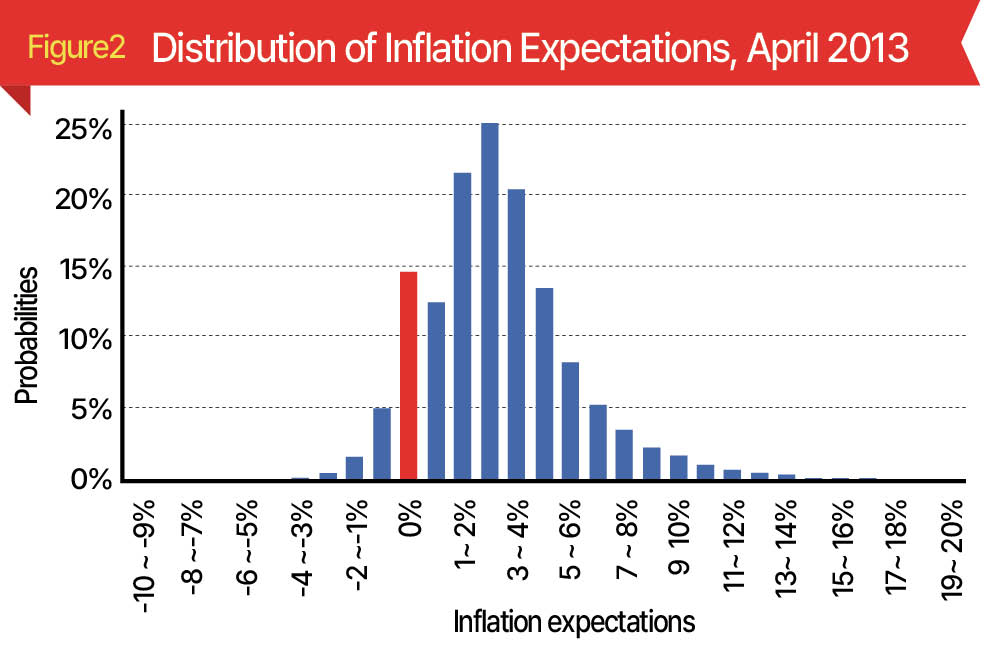
The Zero-Percent Anchor Survived Unconventional Monetary Easing What happened after the introduction of inflation targeting? Figure 2 shows the distribution in April 2013, when the new inflation target was in place and the BOJ, under Governor Haruhiko Kuroda, launched its unprecedented monetary easing program.
The concentration at zero was clearly smaller than a year earlier. This suggests that Kuroda’s strong commitment to ending deflation, combined with aggressive quantitative easing, may have shifted household inflation expectations. But the zeropercent anchor did not continue to weaken steadily thereafter.
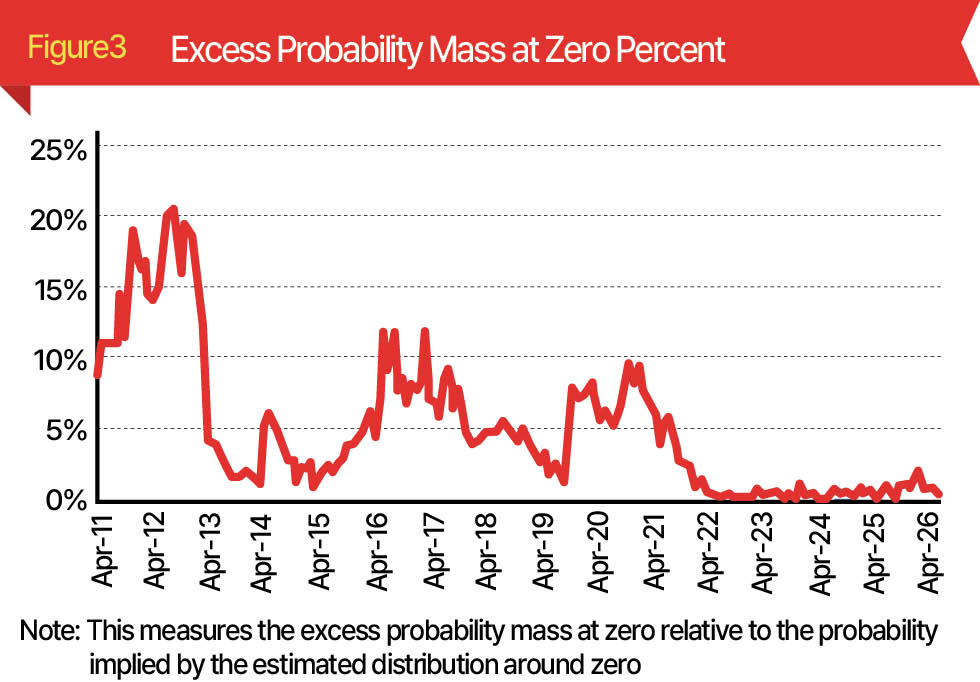
Figure 3 measures the excess probability mass at zero at each point in time.
Specifically, it quantifies how much the observed probability at zero exceeds the probability implied by the estimated distribution in the neighborhood around zero.
The measure fell sharply in the spring of 2013, but subsequently rose again. It never returned to its pre-inflation-targeting level, yet the belief that “prices do not rise”
clearly remained deeply entrenched even under the BOJ’s unconventional easing. When Kuroda stepped down in 2023, he reflected that Japan’s long experience with deflation had left deeply rooted “norms”-ways of thinking and practices based on the assumption that wages and prices would not rise-and that these had prevented the BOJ from achieving its 2 percent target in a sustainable and stable manner. These “norms” overlap substantially with what I call the zero-percent anchor.
As noted above, the zero-percent anchor contributed to price stability. But once the BOJ sought to end deflation, the same anchor became an obstacle to monetary policy.
The very feature that made inflation expectations resistant to external inflationary pressures also made them resistant to the BOJ’s attempts to raise them through monetary easing.
Normally, if a central bank credibly commits to maintaining monetary accommodation into the future, people may come to expect higher inflation. That change in expectations can in turn raise inflation today.
But under a strong zero-percent anchor, people continue to believe that, ultimately, prices will not rise. In that environment, even a commitment to prolonged monetary easing may fail to raise inflation expectations sufficiently. The resulting effect on current inflation will also be weaker.
Since 2022, the Zero-Percent Anchor Has Largely Disappeared The situation began to change markedly after 2021. As Figure 3 shows, the concentration at zero initially increased after the onset of the pandemic. It began to decline in the spring of 2021 and, from the spring of 2022 onward, has remained at very low levels.
The spring of 2022 also marked when Japan entered its current inflationary phase, and firms began passing higher costs through to prices across a broad range of goods and services. This greater willingness to raise prices reflected not only higher input costs but also a shift in firms’ perceptions: they increasingly believed that consumers would accept price increases.

Figure 4 shows the distribution of inflation expectations in February 2026, immediately before the outbreak of the Iran war. The striking peak at zero observed in 2012 has almost disappeared. This suggests that de-anchoring from zero is now well advanced.
The concentration at zero has not entirely disappeared, however. By age group, younger households remain more likely to expect zero inflation. Having spent their formative years during Japan’s long period of deflation, younger generations may still be more strongly influenced by the deflationary mindset than older generations.
The Problem Is That Expectations Are Not Anchored at 2 Percent The weakening of the zero-percent anchor is broadly consistent with what the BOJ had long sought to achieve. However, in a September 2013 speech, Kuroda emphasized that breaking the zero-percent anchor was only one part of the task. The next challenge was to re-anchor inflation expectations at 2 percent. Governor Kazuo Ueda expressed a similar view in a May 2025 speech.
How much progress has Japan made toward re-anchoring expectations at 2 percent? Returning to Figure 4, re-anchoring at 2 percent would mean a greater concentration of probability around 2 percent. In February 2026, the peak of the distribution was between 3 and 4 percent-not too far from 2 percent.
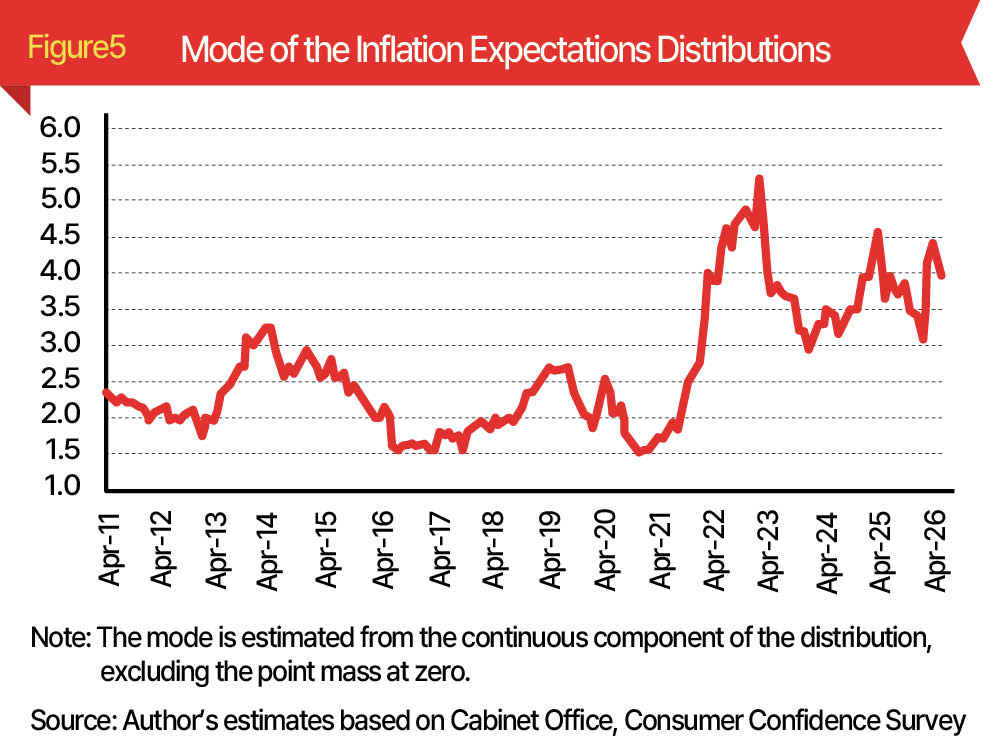
But should we regard this as evidence that expectations have been re-anchored at 2 percent? To examine this question, Figure 5 plots the estimated mode of the distribution-the peak of the distribution excluding the mass at zero-for each month.
The mode stood at 3.1 percent in February 2026. It rose to 4.1 percent in March and 4.4 percent in April. The Iran war broke out during this period and likely contributed to the shift. In just two months, from immediately before the outbreak of the war to April, the mode increased by 1.3 percentage points.
What does the sensitivity of the mode to an external shock tell us? Even with a strong anchor, one-year-ahead inflation expectations can move in response to shocks. But the response should be limited, with the distribution remaining tightly concentrated
around the target.
That is not what happened. The most likely point in the distribution itself shifted by more than one percentage point in a very short period. This suggests that 2 percent has not yet become a sufficiently well-established reference point in households’ expectations.
Building an Anchor Requires a Track Record Why has re-anchoring to 2 percent made so little progress? The institutional framework is already in place: the BOJ has maintained a 2 percent price stability target since 2013. What is missing is a policy track record.
When inflation rises above target, a central bank tightens monetary policy, which brings inflation back toward 2 percent. As this pattern repeats, people learn that even if a shock temporarily pushes inflation above target, it will eventually return to 2 percent.
Major central banks in the United States and Europe did precisely this in response to the surge in inflation after 2021, raising interest rates quickly and bringing inflation down. By contrast, the BOJ has little experience bringing excessively high inflation back to 2 percent.
During Kuroda’s ten years as governor, the challenge was to raise inflation to 2 percent in the first place, so there was no occasion for monetary tightening. Under Ueda, the BOJ has raised interest rates, but the central aim of policy has still been to nurture inflation that had long been too low, rather than to act as an inflation fighter determined to suppress excessive inflation.
From the perspective of households, the question remains unanswered by actual policy experience: If inflation rises substantially, will the BOJ really bring it back to 2 percent?
Without confidence in the answer, it will be difficult to establish a credible 2 percent anchor.
A Missing Nominal Anchor Makes Prices and the Yen More Vulnerable The implication is that Japan is currently in an interregnum between nominal anchors.
The old zero-percent anchor has largely disappeared, while a new 2 percent anchor has yet to take hold.
In general, an economy without a credible nominal anchor is more vulnerable to shocks-such as surges in oil prices, geopolitical disruptions, and natural disasters.
Such shocks can cause larger swings in inflation expectations and, in turn, greater volatility in actual inflation. The resulting instability is sometimes likened to a kite whose string has been cut.
The same logic applies to exchange rates. When people lack a firm view of the future value of money, exchange rates can become excessively sensitive to shocks. History offers many episodes in which the loss of confidence in a nominal anchor has been accompanied by severe instability in a currency‘s value.
What about Japan today? Whether Japanese inflation has already become a “kite without a string” is open to debate. The yen, however, has depreciated substantially against the dollar since 2021, when the zero-percent anchor began to weaken. Of course, the weakening of the anchor cannot explain all of the yen’s depreciation. But uncertainty about future inflation and the BOJ’s policy response may be one factor affecting the exchange rate.
One possible factor behind the weak yen is a view among overseas investors that Japanese inflation has further to rise and that the BOJ may not respond forcefully enough. Whether that view will prove correct remains to be seen. But financial markets are clearly paying attention to the risk that inflation in Japan could become substantially less stable.
There is also a more immediate issue. The BOJ expects underlying inflation to continue rising and to reach 2 percent in the second half of fiscal 2026.
In an ideal world where inflation expectations are firmly anchored at 2 percent, the behavior of households and firms itself creates forces that pull inflation back toward 2 percent. The central bank can take advantage of those stabilizing forces.
But without such an anchor, there is no guarantee that inflation will stabilize on its own once it reaches 2 percent. It may simply pass through 2 percent and continue to rise. If that happens, keeping inflation close to 2 percent will depend more heavily than ever on the BOJ’s policy response.
That is why Japan urgently needs to turn 2 percent from a policy target on paper into a genuine anchor for people’s expectations.
hongi@heraldcorp.com


![‘미국 망하지 않으면 안전?’ 美국채 투자 인기인데…원금 지키는 투자법이 있다 [Deep Spot]](https://wimg.heraldcorp.com/news/cms/2026/10/13/news-p.v1.20260904.5dadfb5404fb467f906a01b3a4ba1592_T1.jpg?type=h&h=640)
![수술 후 변해버린 아버지, ‘마약류’ 맞고 결국 아들 곁 떠났다 [메디컬 생존 게임]](https://wimg.heraldcorp.com/news/cms/2026/10/13/news-p.v1.20261013.41bea7ca77d8444ea752a291f899dc38_T1.jpg?type=h&h=240)
![정산 [‘오늘’에 대한 우리 이야기]](https://wimg.heraldcorp.com/news/cms/2026/10/12/news-p.v1.20261012.baa426e364ad488a8af2050d291e60f9_T1.png?type=h&h=240)