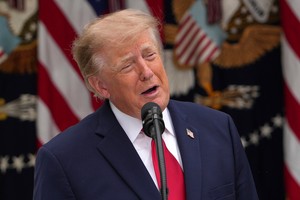
![미국 도널드 트럼프 대통령이 2025년 1월 25일 네바다주 라스베이거스에서 팁 세금 폐지 정책에 대해 연설하고 있다. [로이터]](https://wimg.heraldcorp.com/news/cms/2025/11/19/news-p.v1.20251116.30be939268e148f88d8f4f6a3d9bdb32_P1.jpg)

미국은 어디로 향하고 있는가? 미국의 미래를 어떻게 보는가는 누구의 말을 듣느냐에 따라 달라진다. 일부 전문가들은 경제 전망이 암울하며, 심하면 재앙 수준이라고 본다. 그들은 미국인들이 ‘점점 더 적은 가치에 더 많은 비용을 지불하고 있다’는 느낌, 즉 가성비 문제(affordability issue)가 사라지지 않고 있다고 지적한다. 뉴욕시에서 사회주의자가 시장으로 선출된 것이 바로 이 문제를 중심으로 한 선거였다는 점이 이를 증명한다.
최근 정부 셧다운이 종료되었지만, 트럼프 대통령의 경제 책임자 케빈 해셋(Kevin Hassett)은 이번 사태가 4분기 GDP 성장률을 절반으로 줄일 수 있다고 경고한다. 기존 예상치 3%가 1.5%로 낮아질 수 있다는 것이다. 한편 연간 인플레이션은 여전히 3% 가까이에서 완강하게 머물고 있다.
트럼프의 관세 인상 정책은 현재 미국 대법원의 판결을 기다리고 있다. 부정적 판결이 나오면 최근 국제 무역 협정이 불확실해질 수 있다. 한편 미국의 주요 기술 기업들은 전방위로 감원을 진행하고 있으며, 많은 기업이 AI를 고용 감소의 주된 원인으로 지목하고 있다.
이코노미스트·유고브(YouGov)의 최신 조사에 따르면, 독립 유권자 62%가 “미국 경제가 악화하고 있다”고 응답했으며, 이는 2022년 여름 이후 가장 높은 수치다. NYU 경제학자 로런스 화이트(Laurence White)는 이제 트럼프가 경제 문제를 전임자 바이든에게 돌릴 수 없다고 말한다. “이제 경제는 그의 책임이다”라는 말에는 약간의 즐거움도 담겨 있다.
사실 화이트의 말은 맞지만, 실상은 그가 상상하는 방식과는 다르다. 지난 9개월 동안 트럼프는 2026년 미국 경제 호황을 위한 기반을 다지는 데 집중해왔다.
이 과정에서 한국과 같은 동맹국이 단순한 고객이 아닌 파트너로 참여할 수 있는 국제 경제·기술 질서를 구축하고 있으며, 중국은 점점 소외되고 있다.
미국 주식시장의 성과 역시 미래에 대한 낙관을 반영한다. 나스닥은 2025년 들어 약 21~22% 상승했으며, 다우존스 산업평균지수는 거의 매주 신기록을 세우고 있다. S&P 500은 배당금을 포함한 총 수익 기준으로 17.66% 상승했다.
이처럼 시장이 활기를 띠는 이유는 명확하다. AI 인프라의 급속한 확장에 힘입어 미국 경제에 투자 붐이 일고 있기 때문이다. 엔비디아 CEO 젠슨 황(Jensen Huang)은 향후 10년간 데이터센터와 관련 하드웨어 구축에만 3~4조 달러가 투자될 것이라고 추정했다.
기업 전반의 자본 지출도 눈에 띄게 증가했다. 2025년 상반기 미국 기업들의 자본 지출은 2024년 같은 기간 대비 14.8% 증가했으며, 이는 팬데믹 이후 최대 수준이다. 비자본적 투자, 즉 소프트웨어나 연구개발(R&D) 같은 지적 재산 투자 역시 11.9% 증가하며, 미래 혁신과 고용 확대를 위한 기반을 마련하고 있다.
이러한 흐름의 배경에는 트럼프의 감세 정책과 제조업 투자세액공제 확대가 있다. 존슨앤드존슨은 4년간 미국 내 운영에 550억 달러를 투자하기로 한 데 이어, 노스캐롤라이나 시설에 추가로 20억 달러를 투자한다고 발표했다. 2022년 통과된 반도체법(CHIPS and Science Act)도 반도체와 첨단 기술 제조에 520억 달러를 투입하며 경제 붐을 지원하고 있다.
트럼프 법안은 기업뿐 아니라 일반 시민에게도 혜택을 준다. 사회보장세 제한, 초과근무 및 팁 과세 폐지 등을 통해 개인 소득이 늘어나면서 소비와 투자가 확대될 수 있다. 내년에는 약 2000억 달러가 추가로 개인 경제에 돌아갈 것으로 전망된다.
관세 정책 또한 국제 무역 전쟁으로 이어지지 않았다. 한국을 비롯한 여러 국가와 협상을 통해 연방 수익을 늘리고, 총 17조 달러 규모의 새로운 무역 및 외국인 투자 협정을 체결했다. 오늘날 미국은 세계 최대 외국인 직접투자(FDI) 유치국이며, 아랍에미리트, 카타르, 사우디아라비아, 일본, 한국 등과 거대한 투자 협정을 맺었다.
미국의 에너지 생산과 수출도 경제 호황을 뒷받침한다. 하루 1400만 배럴의 석유 생산과 천연가스 수출 증가, 그리고 원자력 확대를 통해 AI 데이터센터 확장에 필요한 전력을 확보하고 있다. 낮아진 연료비는 운송비를 줄이고, 이는 전반적인 생산 비용 감소로 이어진다.
트럼프 행정부는 암호화폐 활용과 달러 기반 스테이블코인 확대를 지원하며, 달러와 암호화폐가 상호 보완적으로 경제 안정과 기축 통화 역할을 수행할 수 있도록 하고 있다. 중국이 추진해온 디지털 위안과 브릭스(BRICS) 통화 전략은 사실상 실패했고, 대안으로 떠오른 것은 금과 미국의 희토류 공급망 확보 정책이다.
중국 경제는 과잉생산, 내수 부진, 부동산 위기, 높은 청년 실업률 등으로 어려움을 겪고 있다. 이에 비해 미국은 개방적이고 혁신적인 경제 구조를 구축하며, 한국 등 동맹국에 새로운 기회를 제공하고 있다. 한국은 첨단 전자, 반도체, 통신 장비, 공작기계 분야에서 전문성을 갖춰 다가오는 경제 호황에 적극 참여할 수 있다. 또한 AI 협력, 상업·해군 조선, 양자 통신 등 다양한 분야에서 미국과 협력하며 글로벌 경쟁에서 중국을 견제할 수 있다.
1970~1980년대와 달리, 이제 선진 민주국들은 기술과 공급망 등 모든 분야에서 협력해야 21세기가 ‘중국의 세기’가 되는 것을 막을 수 있다. 그리고 미국의 다가오는 경제 호황이 그 길을 선도할 것이다.
![US President Donald Trump speaks on his policy to end tax on tips in Las Vegas, Nevada, on January 25, 2025. [REUTERS]](https://wimg.heraldcorp.com/news/cms/2025/11/19/news-p.v1.20251119.dfe27144fe654d879112504e869e5109_P1.jpg)

America’s Coming Boom
Where is America going? It depends on who you listen to.
Some pundits see its economic outlook as gloomy, if not disastrous. They point out that the affordability issue, i.e. that Americans sense they are paying more for less, isn’t going away; the election of a socialist as mayor of New York City who campaigned precisely on that issue, indicates the opposite. And although the recent government shutdown has ended, President Trump’s economics chief Kevin Hassett predicts it will mean it cuts fourth quarter GDP growth in half-from a projected three percent growth to perhaps one and a half percent. Meanwhile, annual inflation remains stubbornly high, hovering just under three percent.
As for Trump’s effort to raise tariffs, its fate now hangs in the balance in the US Supreme Court. An unfavorable ruling could throw Trump’s recent international trade deals into serious doubt. Meanwhile, America’s leading tech corporations are cutting jobs on every side, with many blaming AI for the employment losses.
According to The Economist/YouGov’s latest tracking poll, 62 percent of independent American voters now say the economy is “getting worse,” the highest level since the summer of 2022. NYU economist Laurence White says Trump can no longer blame his predecessor Joe Biden for his economic woes: “It’s his economy now,” White says, with ill-disguised relish.
In fact, White is correct-but not in the way he imagines. The truth is, for the last nine months Trump has been busily laying the foundations for an American economic boom in 2026. In so doing, he is also creating an international economic and technological order in which allies like ROK can participate as partners, not clients; while China is increasingly left in the cold and dark.
Certainly the performance of American equity markets reflects a growing optimism, not pessimism, about the future-despite some recent downturns on worries about whether the Federal Reserve will do another rate cut. As of mid-November, the Nasdaq-the bellwether of the health of the US tech industry-- has gained approximately 21% to 22% in 2025. The Dow Jones Industrials has set new record highs almost every week, while the S&P 500 is up by 17.66% when you count total returns (including dividends).
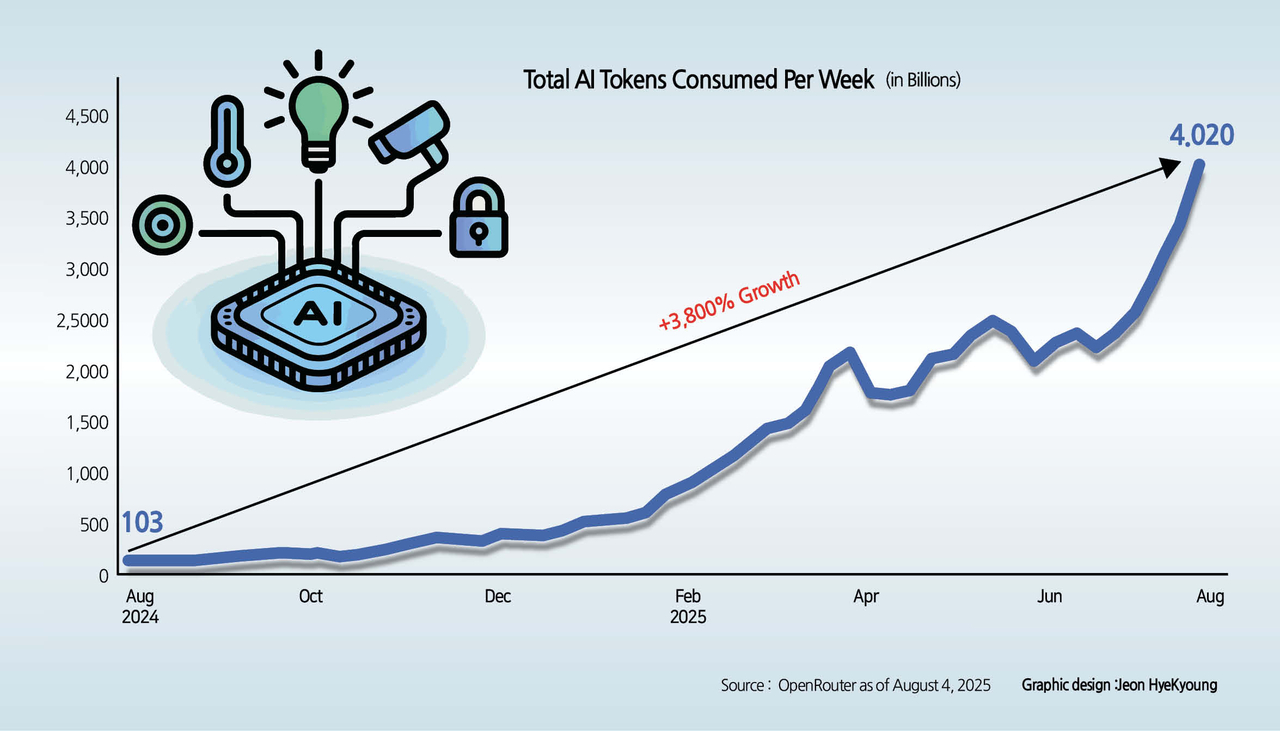
And no wonder the markets have been happy. An investment boom in the US economy is already underway, primarily driven by the rapid buildout of AI infrastructure. Nvidia chief executive Jensen Huang estimated on the company’s latest earnings call that between $3 trillion to $4 trillion will be spent on AI infrastructure by the end of the decade, especially for construction of data centers and related hardware.
But there’s also been a stunning rise in capital expenditure across the business landscape. Those expenditures grew by 14.8 percent in the first half of 2025 compared with the same period in 2024, according to the Bureau of Economic Analysis. It’s the biggest non-pandemic gain since 2011.
But one of the most overlooked data points is non-capital business spending, which includes investment in intellectual property such as software and on research and development. That number is up 11.9 percent this year from same time frame in 2024. That kind of investment sets the table for future innovation-based growth, which means future hirings as well.
Why is this happening? Companies like Johnson & Johnson have cited lower corporate taxes and deductions on domestic R&D expenses promised in Trump’s so-called “big, beautiful” tax reduction bill, as well as the expansion of a manufacturing investment tax credit. In September, in fact, Johnson & Johnson chief executive Joaquin Duato announced an additional $2 billion investment in its North Carolina facility, on top of the previously announced $55 billion it committed for U.S. operations for the next four years.
In fact, real business investment in manufacturing structures has increased sharply since late 2022, boosting GDP growth, according to the Peterson Institute for International Economics. Some of this boom is due to the CHIPS and Science Act passed in 2022, which poured $52 billion into boosting U.S. semiconductor production and other tech manufacturing.
But Trump’s tax bill has added more fuel to business investment by allowing more tax credits for inshore investing-companies are deciding that investing in U.S.-based production makes sense in order to reduce reliance on foreign sources and make their supply chains more secure, especially for critical technologies-and a provision for one hundred percent depreciation expensing, including for manufacturing equipment.
The tax advantages in Trump’s bill aren’t just for companies and corporations. The same tax bill brings substantial tax savings for ordinary Americans through tax breaks such as limiting taxes on Social Security and ending taxes on overtime and tips. This means people will have more personal income to spend and invest-perhaps as much as $200 billion next year.
Then there’s Trump tariff boom. Contrary to the experts, it hasn’t triggered an international trade war. Instead, it has resulted in a series of negotiated agreements with countries like South Korea, which have boosted federal revenues but also brought a cascading series of new trading and foreign investment arrangements, both public and private, totaling some $17 trillion on paper.
Today the U.S. is the number one destination globally for foreign direct investment. Some of the deals Trump has reached, are staggering.
From the Arab Emirates, a $1.4 trillion investment framework in the U.S. over a decade. With Qatar, an agreement to generate a $1.2 trillion “economic exchange” and a $600 billion “investments and trade” commitment with Saudi Arabia.
Japan meanwhile has agreed to invest $550 billion into American industries, particularly in energy and semiconductors, while South Korea has pledged up to $350 billion in investment into U.S. industries, with an additional commitment for energy purchases.
This latter deal is part of the American energy boom that’s also coming.
Already the United States is producing 14 million barrels a day, while Trump is coordinating with his Middle East partners like the Saudi to keep energy costs low around the globe. U.S. natural gas exports have increased by about 25% this year, with the U.S. Energy Information Administration (EIA) natural gas (LNG) exports, which are set to rise by another 10% in 2026.
More than half of America’s fifty states have now seen gas prices drop below $3 a gallon (under President Biden the national average reached $5 in June 2022). All in all, lower gasoline costs for Americans means lower transportation costs, which means lower costs for everything. That may not guarantee any future price drops for consumers, but it will be a serious check on any inflation still left in the system.
That energy policy is also heavily focused on boosting the electrical power needed to sustain and expand the country’s AI boom. As we noted in a previous column, the investment firm Goldman Sachs estimates that the growth of AI data centers could raise global electrical power demand by as much as 165 percent by 2030. The Trump administration is hoping to meet that demand by expanding the use of nuclear power. It wants America to have 10 new large nuclear reactors under construction by 2030.
All this means that AI/ML in America will have the power it needs to boost productivity across the economy, spawning new jobs in every sector that benefits, from infrastructure construction to manufacturing.
There’s also an American cryptocurrency boom coming, as the Trump administration looks to streamline regulation and ease the use of crypto as an investment vehicle. Trump has also issued an executive order supporting the creation of more dollar-backed stablecoins by private firms, in order to reinforce the dollar‘s global role. Far from seeing the shift to crypto as a threat to the dollar, the Trump team see crypto working side by side with a strong dollar i.e. as a source of economic stability as well as maintaining the dollar as the world’s reserve currency.
Undermining that reserve status has been a key Chinese geopolitical strategy, with initiatives like the digital yuan and the push for creating a BRICS currency. Unfortunately for Bejing, that strategy has backfired. The alternative to the dollar has turned out to be not the digital yuan or even the Euro, but gold. As the world’s largest holder of gold (8,133.46 tonnes compared to China’s 2,303.51tonnes), the United States is well positioned to take advantage of the “gold rush” that’s currently underway in global markets.
The other half of China’s strategy for displacing US economic dominance has been to monopolize critical minerals, particularly rare earths. This time, Beijing showed its hand too soon. Its threat of a worldwide export ban galvanized a Trump policy of creating alternate rare earth supply chain, including deals with key allies like Australia and Japan, and international partners like Malaysia, Thailand, and Vietnam.
For now, China still controls 90% of the world‘s rare earths processing. In two or three years, however, thanks to Trump and the United States, that monopoly may be slipping away.
Meanwhile, China’s economy is not looking so strong, either-certainly by comparison with the American outlook in 2026.
China struggles with overproduction and weak domestic demand. It’s in the midst of a real estate crisis, and chronic uncertainty about job security with a stubbornly high youth unemployment rate (now at 17percent). The economy that was supposed to dominate the 21st century, is looking very shaky. The fact is, a command economy like Communist China cannot compete with the kind of open, innovative, and competitive economy the US is reconstructing, including in technology and manufacturing-and one that also brings opportunities for America’s partners.
Here Korea is perfectly poised to join in the coming boom, given its expertise in advanced electronics, semiconductors (including memory chips), telecommunications equipment, and machine tools. Korea is also one of the key countries with whom Trump has signed an AI cooperation agreement, alongside Japan and the Arab Emirates, that will help to prevent China from dominating the global AI landscape.
As for commercial and naval shipbuilding-an area where the United States urgently needs help, especially vis a vis China’s surging maritime output--South Korea can bring enormous expertise and scalability to America’s shipyards.
Korea can also show the US a thing or two about quantum communications, with companies like Samsung and SK Telecom demonstrating how to make vital infrastructures safe and secure, including against future quantum computer attacks.
In the bad old days of the 1970’s and 1980’s, when economic growth seemed destined to be a zero-sum game, US was engaged in a more or less permanent struggle with surging Asian economies like Japan and South Korea, for market dominance. Now the advanced democracies are realizing they have to work together in everything from advanced technologies to supply chains, in order to keep the 21st century from becoming “the Chinese century”-which would be a net loss for everyone.
And America’s coming economic boom will lead the way.
hongi@heraldcorp.com


![임영웅 51억에 산 집, 이젠 120억…하하·정동원도 사는 ‘강북판 타워팰리스’[초고가 주택 그들이 사는 세상]](https://wimg.heraldcorp.com/news/cms/2026/10/17/news-p.v1.20261016.f574b812626d48019a4018618b827c5b_T1.jpg?type=h&h=640)
![“샌디스크도 아니었다”…S&P500 상승률 1위, 7배 뛴 이 종목[서학개미 주식회사]](https://wimg.heraldcorp.com/news/cms/2026/10/15/news-p.v1.20251010.236fb20db3324e3bbd6f1dba7ec63bff_T1.jpg?type=h&h=240)
![[르포] 공장 들어서자 ‘밥 냄새’가 훅…쿠첸 ‘티타늄 밥솥’ 의 비밀[그 회사 어때?]](https://wimg.heraldcorp.com/news/cms/2026/10/16/news-p.v1.20260923.16e9b0f48f08469fa1014f2864f8e8fc_T1.jpg?type=h&h=240)
![장기금리와 그린스펀의 수수께끼…이번엔 뒤집혔다 [지안루카 베니그노]](https://wimg.heraldcorp.com/news/cms/2026/10/14/news-p.v1.20261012.37af49395c5e42388798ef9d8de6e08b_T1.jpg?type=h&h=240)