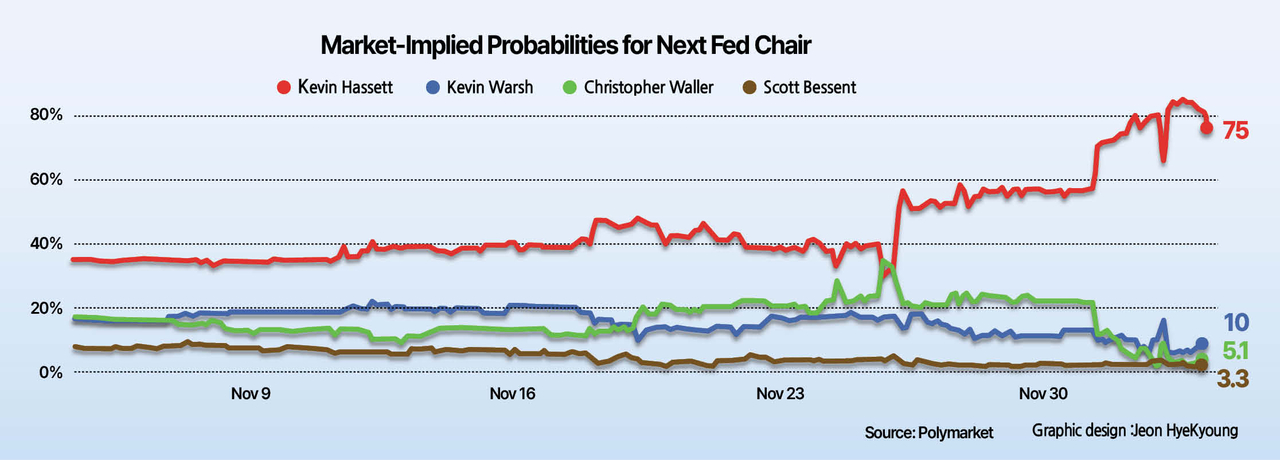
미국 연방준비제도(Fed·연준)가 12월 회의에서 기준금리를 인하할 것이라는 기대가 커지고 있다. 이 경우 금리인하 반대 의견이 나올 가능성도 제기된다. 차기 연준 의장 발표는 내년 1월로 연기될 전망이다. 블록체인 기반 예측시장 플랫폼 폴리마켓에 따르면 유력 후보 중에선 케빈 해싯 백악관 국가경제위원회(NEC) 위원장이 가장 높은 가능성을 보이고 있다.
트럼프 행정부가 낮은 금리를 선호한다는 건 잘 알려져 있다. 그러나 이번 인선의 의미는 단기적인 정책 방향을 훨씬 넘어선다. 새로운 의장은 연준의 지적·분석적 틀을 근본적으로 재구성하고, 사실상 완전히 새로운 통화정책 플레이북(playbook·운용 전략)을 작성할 수 있다. 팬데믹 이후의 경제는 글로벌 금융위기 이후의 시대를 규정했던 힘들과 전혀 다른 동력으로 움직이고 있다. 연준의 최근 전략적 검토는 향후 닥칠 도전의 규모를 과소평가했을 가능성이 크다.
진짜 질문은 다음과 같다. AI가 촉발한 생산성, 확장적 재정정책, 노동대체, 공급망 분절, 은행대출보단 레버리지가 경기 사이클을 좌우하는 금융시스템으로 움직이는 이 경제에 현재의 정책 틀이 과연 충분한가 하는 점이다. 차기 연준 의장은 기존의 ‘플레이북’으로는 더 이상 설명되지 않는 세계를 물려받게 될 것이다.
코로나 이전의 플레이북
글로벌 금융위기와 코로나19 사이의 10년은 통화정책을 인플레이션(물가상승)의 주된 동력으로 삼으려는 지속적 노력이 있던 때다. 연준은 금리를 제로(0) 수준까지 내리고, 여러 차례 양적완화를 시행했으며, 점점 더 명확한 형태의 포워드 가이던스(금리전망)를 제시했다. 팬데믹 직전에는 평균물가목표제같은 ‘보상적(make-up) 전략’도 도입했다. 이 시기는 장기침체(secular stagnation) 논쟁과 구조적으로 낮은 중립실질금리에 대한 합의가 지배한 시기이기도 했다.
그러나 정책 도구는 비약적으로 확대됐는데도, 연준의 근본적 거시경제 프레임워크는 위기 이전 ‘대안정기(Great Moderation·1980년대 중반~2007년 금융위기 직전)’와 본질적으로 동일하게 유지됐다. 단기 정책금리를 조정하면 초단기 조달비용에 영향을 미치고, 은행 시스템을 통해 이를 매끄럽게 전달하며, 신용 여건을 바꾸고, 총수요를 조절해 결국 인플레이션을 관리한다는 사고방식이었다. 정책수단이 늘고 금리가 사실상 하한선에 붙어 있어도, 기본적으로는 금리 중심 패러다임이 유지된 셈이다.
한편 연준의 분석 모델은 여전히 옛 프레임워크에 기반한 채 남아 있었지만, 정책 운영 체계는 크게 변화했다. 2008년 이후의 대규모 자산매입은 시스템을 ‘준비금 부족 체제’에서 오늘날의 ‘준비금 풍부 체제(플로어 시스템)’로 전환시켰다. 이는 개념적 틀은 그대로였지만, 정책을 집행하는 방식 자체를 사실상 바꿔놓은 변화였다.
코로나 이후의 도전
코로나19 팬데믹은 2020년 이전 세계와의 첫 번째 주요 단절을 의미했다. 글로벌 공급망 혼란과 지속적인 재정확대가 결합하며, 글로벌 금융위기 이후와는 근본적으로 다른 인플레이션 양상을 만들어냈다. 인플레이션은 비정상적으로 오랜 기간 목표치를 상회했고, 구성도 달라졌다. 서비스 물가는 특히 끈질기게 높게 유지됐으며, 러시아의 우크라이나 침공으로 시작된 지정학적 충격은 지속적인 공급 측면의 압력을 추가했다.
이러한 변화들은 일시적인 이상 현상이 아니었다. 이는 연준이 지금 활동하고 있는 경제 환경이 정책 주도적이며 구조적으로 근본적 변화를 겪고 있음을 보여주는 초기 신호였다. 이는 통화정책 플레이북을 재고할 필요가 있을 만큼 중요한 수준이다.
동시에 경제는 AI 중심의 기술 전환 국면에 접어들고 있다. 도널드 트럼프 행정부의 정책 의제-이민, 규제, 재정 확대, 관세 부활 등-는 세계화 시대와 확실히 다른 방향을 보여준다. 이들 변화는 각각 독립적으로 발생한 것이 아니라, 지정학적 질서와 경제적 우선순위가 함께 재편되는 흐름 속에서 나타나고 있다.
최근 논평, 예를 들어 스티븐 미란 연준 이사의 중립실질금리 관련 연설은 이러한 주로 비통화적 요인들이 장기 균형 조건을 어떻게 바꿀 수 있는지를 탐구하기 시작했다. 하지만 이러한 분석조차도 여전히 중립실질금리가 정의된 전통적 틀 안에 머물러 있다. 더 큰 질문은 그 틀 자체가 여전히 적절한가 하는 점이다. 새로 등장한 도전 과제는 연준의 기존 지적 모델 전체에 영향을 미치고 있다.
미국 노동시장은 현재 AI, 로봇, 자동화에 의해 촉발된 구조적 생산성 충격을 겪고 있다. 이 기술들은 인터넷이 1990년대 말과 2000년대 초 그랬던 것처럼 노동을 보완하는 것이 아니라, 노동을 대체하도록 설계됐다. 기업들은 ‘더 적은 인력으로 더 많은 일을 한다(do more with less)’는 방향으로 움직이고 있으며, 이는 순환적 변화가 아닌 장기적 구조 변화다.
인터넷 시대는 전자상거래와 디지털 서비스 분야에서 새로운 일자리를 창출했지만, AI는 새로운 고숙련 일자리를 만드는 속도보다 기존 일자리를 빠르게 대체한다. 그 결과 노동수요는 약해지고, 중간숙련 직종은 압박을 받으며, 임금 분포는 더욱 양극화된다. 이는 오늘날 미국 경제의 ‘K자형’ 구조를 설명하는 핵심이다. 동시에, 수십 년간의 깊은 통합 이후 지정학적 분절화가 진행되고 있다. 이러한 환경에서 공급망을 재설계하는 일은 느리고, 비대칭적이며, 인플레이션을 자극할 수 있다. 여기에 새로운 재정 현실이 더해진다. 민간 부문이 아니라 연방정부가 총수요와 거시경제 성과를 주도하는 시대가 도래한 것이다.
이 모든 요인이 결합하며, 경제는 단순한 경기 순환이 아니라 깊은 구조적 변화로 정의되는 환경이 됐다. 구조적 세계는 과거의 순환적 플레이북만으로는 관리될 수 없다.

변화하는 통화정책 전파 경로
두 번째 주요 변화는 통화정책이 경제에 전파되는 방식이다. 과거처럼 정책금리 변동이 은행 대출, 가계 차입, 기업 투자, 총수요에 영향을 주던 경로는 크게 약화했다. 이제 정책금리는 경제의 전혀 다른 부문을 통해 효과를 낸다. 연준기금금리(Fed Funds Rate)는 여전히 중요하지만, 그 영향력은 이제 가계나 기업의 신용 결정이 아니라 금융시장에 집중돼 있다. 단기 금리는 담보부 단기금리(SOFR)를 고정하고, SOFR는 레포(Repo·증권을 담보로 한 단기 자금 거래) 시장을 고정한다. 레포 금리는 헤지펀드, 딜러, 모기지 리츠, 베이시스 트레이더 등 금융기관들의 레버리지 비용을 결정한다.
금융화가 심화한 경제에서는 통화정책이 점점 더 레버리지, 담보 평가, 딜러의 대차대조표 용량, 유동성 조건을 통해 작동한다. 전통적 경제 모델에서 상정했던 ‘IS-LM 전파’, 즉 단기 금리 조정이 은행 대출을 거쳐 투자와 소비, 총수요에 영향을 주는 순차적 과정은 더 이상 실물경제에서 강력하게 작동하지 않는다. 이 때문에 실물경제가 거의 반응하지 않아도 금융시장은 크게 움직일 수 있고, 정책금리를 조정해도 투자나 소비를 자극하는 효과가 제한적이다.
이것이 새로운 체제의 핵심 특징이다. 즉, 금융 시스템 자체는 실물경제보다 단기 정책금리에 훨씬 민감하게 반응한다.
실물경제에서는 중요한 게 초단기 금리(overnight rate)가 아니라 10년 만기 국채 수익률이다. 이 수익률은 주택담보대출 금리와 기업 차입금리를 결정한다. 장기 금리는 연준기금금리(Fed Funds Rate)와는 느슨하게 연결돼 있으며, 대신 규제상 대차대조표 제약, 글로벌 저축 흐름, 국채 발행, 만기 수요, 위험 프리미엄 등에 의해 형성된다.
따라서 정책금리 변화가 실물경제에 전달되는 효과가 약해진 것은 놀라운 일이 아니다. 대기업들은 점점 더 차입 대신 유보이익(retained earnings)으로 자본 지출을 충당한다. 주택담보대출 금리는 정책금리가 아니라 만기 프리미엄(term premium)과 채권시장 변동성에 의해 결정되며, 장기 모기지의 경우 금리 인하 효과가 가계에 전달되는 속도가 느리다. 소규모 기업들은 주로 신용 기준과 담보 요구에 의해 제약을 받지 초단기 자금조달 비용에는 큰 영향을 받지 않는다.
가계와 기업이 정책금리 변화에 거의 반응하지 않을 때, 기존 교과서적 채널-금리를 올려 수요를 억제하고, 금리를 내려 수요를 자극하는 방식-은 자연히 효과가 제한적이 된다.
대신, 현재 주요 정책 전달 메커니즘은 금융시장과 가계 대차대조표의 상호작용을 통해 작동한다. 요약하면 ‘레포→레버리지→유동성→자산가격→가계의 부(wealth)→소비’의 상호작용이다.
이미 연준은 금융여건을 모니터링하고 있지만, 오늘날의 전파 메커니즘은 훨씬 더 깊이 있는 시장구조 분석을 요구한다. 자산가격이 단기 차입비용보다 더 즉각적으로 수요에 영향을 미치기 때문이다.
로리 로건 댈러스 연은 총재가 최근 지적했듯, 현재 시장구조는 단기 무담보금리가 아니라 담보부 단기금리(레포)가 더 중심적이므로 연준기금금리는 점점 시대에 뒤떨어진 운영 목표가 되고 있다. 로건 총재가 레포 기반 금리(TGCR)를 새로운 정책 타깃으로 제안한 이유다.
새로운 연준 플레이북을 향해
경제 구조가 변화하고, 통화정책의 전달 경로가 은행 대출보다는 금융 시스템과 자산가격을 통해 작동한다면, 연준의 플레이북도 이에 맞춰 적응해야 한다. 과제는 단순히 어떤 정책 수단을 사용할지가 아니라, 순환적 요인 대신 구조적 요인이 경제를 형성하는 상황에서 정책 반응 함수를 어떻게 설계할 것인가에 있다. 핵심 질문은 더 이상 금리를 올릴지 내릴지가 아니라, 기술, 지정학, 재정정책, 시장 구조 변화에 정책이 어떻게 대응해야 하며, 각 과제에 가장 적합한 수단은 무엇인가이다.
통화정책은 더 이상 충격을 안정적 추세에서 벗어난 일시적 변동으로 가정하며 조정할 수 없다. 이제는 구조적 요인들이 잠재 산출을 결정하고, 소득 분포를 재편하며, 정책 효과 자체에 영향을 준다.
거시경제적 관점에서, 만약 실물경제가 장기 금리에 의해 형성된다면, 연준의 대차대조표는 더 중요한 정책 수단이 돼야 한다. 크고 지속적인 대차대조표는 새로운 체제의 특징일 수 있다. 자산매입과 자산 만기 소멸(run-off)은 장기 금리, 특히 주택담보대출과 기업 차입을 결정하는 10년 만기 국채 수익률의 수준과 변동성에 영향을 주기 위해 보다 일상적으로 사용될 수 있다. 이를 ‘수익률 곡선 엔지니어링(yield-curve engineering)’으로 이해하는 것이 적절하다.
지속적인 재정 부양과 높은 공공부채 환경에서는, 대차대조표 정책이 통화 당국과 재정 당국을 연결하는 자연스러운 수단이 된다. 연준은 만기 프리미엄 안정화가 자신의 임무와 일치하는 시점과, 이러한 조치가 사실상 채무 관리(de facto debt management)로 흐를 위험이 있는 시점을 구분해 신중히 고려해야 한다.
반대로, 금리 곡선 단기 구간 관리는 총수요 조절보다는 금융 시스템 관리와 관련된다. 새로운 플레이북에서는 정책금리가 가계나 기업 차입을 직접 조절하는 수단이라기보다 레버리지, 단기 금융시장 조건, 담보부 자금조달 비용을 규제하는 도구로 인식될 것이다. 따라서 금리 결정은 금융 안정성 지표-딜러 대차대조표 제약, 레포시장 기능, 주요 자금시장 변동성-와 보다 명확히 연결될 필요가 있다.
간단히 말해 단기 금리는 연준의 금융 안정성 수단으로 발전할 수 있고, 대차대조표는 거시경제적 도구로서의 역할을 더 크게 맡게 된다.
마지막으로 경제와 지정학이 점점 더 얽혀가는 상황에서, 연준의 플레이북은 관세, 제재, 산업정책, 방위비 증가의 영향을 반영할 필요가 있다. 이러한 요인들은 공급망, 인플레이션, 투자 결정에 전통적 모델이 예상하지 못한 방식으로 영향을 미치고 있으며, 정책 체계 역시 이 새로운 현실에 맞게 적응해야 한다.
새로운 연준 의장이 곧 임명될 예정이다. 하지만 더 중요한 변화는, 연준이 과거에 알고 있던 경제가 아니라, 현재와 미래의 경제에 맞춰 설계된 새로운 통화정책 플레이북이 등장하는 것일 수 있다.

A New Federal Reserve Playbook?
Market expectations now point to a rate cut at the Federal Reserve’s December meeting, probably an outcome that will come with dissents. At the same time, the announcement of the new Fed is going to be postponed to January and Polymarket probabilities for “no announcement by December 31” have adjusted promptly with Kevin Hassett leading among the likely contenders.
The incoming administration’s preference for lower rates is well known, but the stakes extend far beyond the near-term policy stance. The new leader could fundamentally reshape the Fed’s intellectual framework and write an entirely new playbook for monetary policy. The post-pandemic economy is governed by forces very different from those that defined the post-financial-crisis era, and the Fed’s most recent strategic review may have underestimated the scale of the challenges ahead.
The real question is whether the current framework is adequate for an economy driven by AI-enabled productivity, expansive fiscal policy, labour displacement, supply-chain fragmentation, and a financial system where leverage, rather than bank lending, drives the cycle. The next Fed Chair will inherit a world that the old playbook simply does not describe.
The Pre-COVID Playbook
The decade between the global financial crisis and Covid was defined by a persistent effort to use monetary policy as the primary engine of inflation. The Fed cut interest rates to zero, deployed multiple rounds of quantitative easing, offered increasingly explicit forward guidance, and, just before the pandemic, adopted “make-up” strategies such as average inflation targeting. This was also the era of the secular-stagnation debate and the consensus around a structurally low neutral real interest rate, or r*.
Yet despite the extraordinary expansion of the policy toolkit, the Fed’s underlying macroeconomic framework remained essentially the same as in the pre-crisis “Great Moderation” period. The intellectual model assumed that adjusting the short-term policy rate would influence overnight funding costs, transmit smoothly through the banking system, affect credit conditions, steer aggregate demand, and ultimately manage inflation. It was the same interest-rate-centric paradigm, even if the instruments had multiplied and the policy rate had hit its effective lower bound.
While the Fed’s analytical model stayed rooted in the old framework, its operational regime changed significantly. The large-scale asset purchases launched after 2008 shifted the system from a scarce-reserves regime to today’s ample-reserves or floor-system framework, effectively transforming how the Fed implements policy, even as its conceptual framework did not.
The post-COVID Challenges
The Covid pandemic marked the first major break with the pre-2020 world. Global supply-chain disruptions-captured by the New York Fed’s GSCPI-combined with a sustained fiscal expansion to produce an inflation dynamic fundamentally different from the post-GFC era. Inflation has remained above target for an unusually long period, and its composition has shifted: services inflation has been notably persistent, while geopolitical shocks, beginning with Russia’s invasion of Ukraine, have introduced durable supply-side pressures.
These forces were not temporary anomalies. They were early signs of a deeper, policy-driven and structural transformation of the economic environment in which the Fed now operates-changes significant enough to warrant a rethinking of the monetary policy playbook.
At the same time, the economy is entering what appears to be an AI-driven technological transition. The new administration’s agenda-on immigration, regulation, fiscal expansion, and the return of tariffs-marks another clear departure from the globalisation era. None of these developments are isolated; together, they reflect a broader reordering of geopolitical alignments and economic priorities.
Recent commentary, including Steve Miran’s speech on r* (the neutral real interest rate), has begun to explore how these largely nonmonetary forces might shift long-run equilibrium conditions. But even these analyses are bound within the traditional framework in which r* is defined. A larger question is whether that framework itself is still adequate.
The emerging challenges touch every part of the Fed’s existing intellectual model.
The U.S. labour market is now experiencing a structural productivity shock driven by AI, robotics, and automation, technologies designed to replace labour, not complement it as the internet did in the late 1990s and early 2000s. Firms are “doing more with less,” a secular shift rather than a cyclical one. Unlike the internet era, which created new roles across e-commerce and digital services, AI displaces existing jobs faster than it generates new higher skilled-ones. The result is weaker labour demand, pressure on middle-skill occupations, and a more polarised wage distribution. This is the essence of today’s K-shaped economy.
At the same time, geopolitical fragmentation is unfolding after decades of deep integration. Re-engineering supply chains in such a world is potentially slow, asymmetric, and inflationary. Layered on top of this is a new fiscal reality: the federal government, rather than the private sector, has become the primary driver of demand and macroeconomic outcomes (the fiscal primacy hypothesis).
Together, these forces create an environment defined not by cyclical fluctuations but by deep structural change. And a structural world cannot be managed by thinking in terms of a cyclical playbook.
The Evolving Transmission Mechanism
The second major shift concerns how monetary policy transmits through the economy. The traditional channels-where changes in the short-term policy rate influence bank lending, household borrowing, corporate investment, and aggregate demand-are far less effective than in the past. Today, they operate mainly through different parts of the economy.
The Fed Funds Rate still matters, but its influence is now concentrated in financial markets, not in household or corporate credit decisions. The overnight rate anchors SOFR, which anchors repo markets, and repo rates determine the cost of leverage for hedge funds, dealers, mortgage REITs, and basis traders.
In a highly financialised economy, monetary policy increasingly works through leverage, collateral valuation, dealer balance-sheet capacity, and liquidity conditions, not through the IS-LM transmission logic of the Great Moderation. This is why financial markets can move sharply even when the real economy barely reacts, and why adjusting the policy rate often does little to stimulate investment or consumption.
This is the defining feature of the new regime: the financial plumbing is more sensitive to short term policy rate than the real economy
For the real economy, what matters is not the overnight rate but the 10-year Treasury yield, which anchors mortgage rates and corporate borrowing. These long-term rates are only loosely connected to the Fed Funds Rate, shaped instead by regulatory balance-sheet constraints, global savings flows, Treasury issuance, duration demand, and risk premia.
It is therefore unsurprising that transmission to the real economy has weakened. Large corporations increasingly finance capital spending from retained earnings rather than borrowing. Mortgage rates depend on term premia and bond-market volatility, not the policy rate, and longer mortgage durations have slowed the pass-through of rate cuts to households. Small firms are constrained mainly by credit standards and collateral requirements, not overnight funding costs.
When households and businesses respond only weakly to changes in the policy rate, the old textbook channel-raising rates to cool demand, cutting rates to stimulate it-naturally becomes less effective. Instead, the dominant transmission mechanism now runs through the interaction between financial markets and household balance sheets:
repo → leverage → liquidity → asset prices → household wealth → consumption
Although the Fed already monitors financial conditions, the modern transmission mechanism requires a deeper focus on the specific market structures through which policy now operates. Asset prices, rather than short-term borrowing costs, have become the most immediate channel linking policy decisions to aggregate demand. Recognising this shift means placing greater analytical weight on the components of financial conditions that matter for transmission today: dealer balance-sheet capacity, market volatility indicators such as MOVE and VIX, and the functioning of key collateral markets that underpin secured funding.
These elements now drive how policy impulses propagate through the financial system far more powerfully than changes in the overnight rate alone.
Recent remarks by Dallas Fed President Lorie Logan highlight this evolution. She argues that the federal funds rate has become an increasingly outdated operational target in a market structure dominated by secured funding and repo activity. Her suggestion to shift toward a repo-based target, such as the Treasury General Collateral Rate (TGCR), underscoingthe importance of structural shift also in the implmentation of policy.
Towards a New Federal Reserve Playbook
If the structure of the economy has changed, and the transmission of monetary policy now runs less through bank lending and more through financial plumbing and asset prices, then the Fed’s playbook should adapt as well. The challenge is not only about which tools to use, but how to design the reaction function for a world shaped by structural rather than cyclical forces. The key question is no longer just whether to tighten or ease; it is how policy should respond to shifts driven by technology, geopolitics, fiscal policy, and market structure, and which instruments are best suited to each task.
Monetary policy can no longer be calibrated as if shocks were temporary deviations from a stable trend. Structural forces are now determining potential output, reshaping income distribution, and influencing the effectiveness of policy itself.
From a macroeconomic perspective, if long-term yields are what shape the real economy, then the Fed’s balance sheet should become a more prominent policy instrument. A large and persistent balance sheet may simply be a feature of the new regime. Asset purchases and run-off could be used more routinely to influence the level and volatility of long-term rates, especially the 10-year yield that anchors mortgages and corporate borrowing. This approach is best viewed as a form of “yield-curve engineering.”
In an environment of persistent fiscal stimulus and high public debt, balance-sheet policy also becomes the natural interface between monetary and fiscal authorities. The Fed will need to consider when stabilising term premia is consistent with its mandate and when such actions risk drifting into de facto debt management.
By contrast, managing the short end of the curve becomes less about steering aggregate demand and more about governing the financial system. In a new playbook, the policy rate would be seen primarily as a tool for regulating leverage, money-market conditions, and the pricing of secured funding, rather than as the main driver of household or corporate borrowing. This suggests linking rate decisions more explicitly to indicators of financial stability: dealer balance-sheet constraints, repo-market functioning, and volatility in key funding markets.
Put simply, the short-term rate could evolve into the Fed’s financial-stability instrument, while the balance sheet would take more a role as macroeconomic tool.
Finally, as economics and geopolitics become increasingly intertwined, the Fed’s playbook will also need to account for the effects of tariffs, sanctions, industrial policy, and rising defense spending. These forces now shape supply chains, inflation, and investment decisions in ways that traditional models did not anticipate, and the policy framework will need to adapt to this new reality.
A new Fed Chair will soon be appointed. But the more consequential development may be the emergence of a new monetary policy playbook, one designed for the economy as it is becoming, not the one the Fed used to know.
hongi@heraldcorp.com


![임영웅 51억에 산 집, 이젠 120억…하하·정동원도 사는 ‘강북판 타워팰리스’[초고가 주택 그들이 사는 세상]](https://wimg.heraldcorp.com/news/cms/2026/10/17/news-p.v1.20261016.f574b812626d48019a4018618b827c5b_T1.jpg?type=h&h=640)
![“샌디스크도 아니었다”…S&P500 상승률 1위, 7배 뛴 이 종목[서학개미 주식회사]](https://wimg.heraldcorp.com/news/cms/2026/10/15/news-p.v1.20251010.236fb20db3324e3bbd6f1dba7ec63bff_T1.jpg?type=h&h=240)
![[르포] 공장 들어서자 ‘밥 냄새’가 훅…쿠첸 ‘티타늄 밥솥’ 의 비밀[그 회사 어때?]](https://wimg.heraldcorp.com/news/cms/2026/10/16/news-p.v1.20260923.16e9b0f48f08469fa1014f2864f8e8fc_T1.jpg?type=h&h=240)
![장기금리와 그린스펀의 수수께끼…이번엔 뒤집혔다 [지안루카 베니그노]](https://wimg.heraldcorp.com/news/cms/2026/10/14/news-p.v1.20261012.37af49395c5e42388798ef9d8de6e08b_T1.jpg?type=h&h=240)